
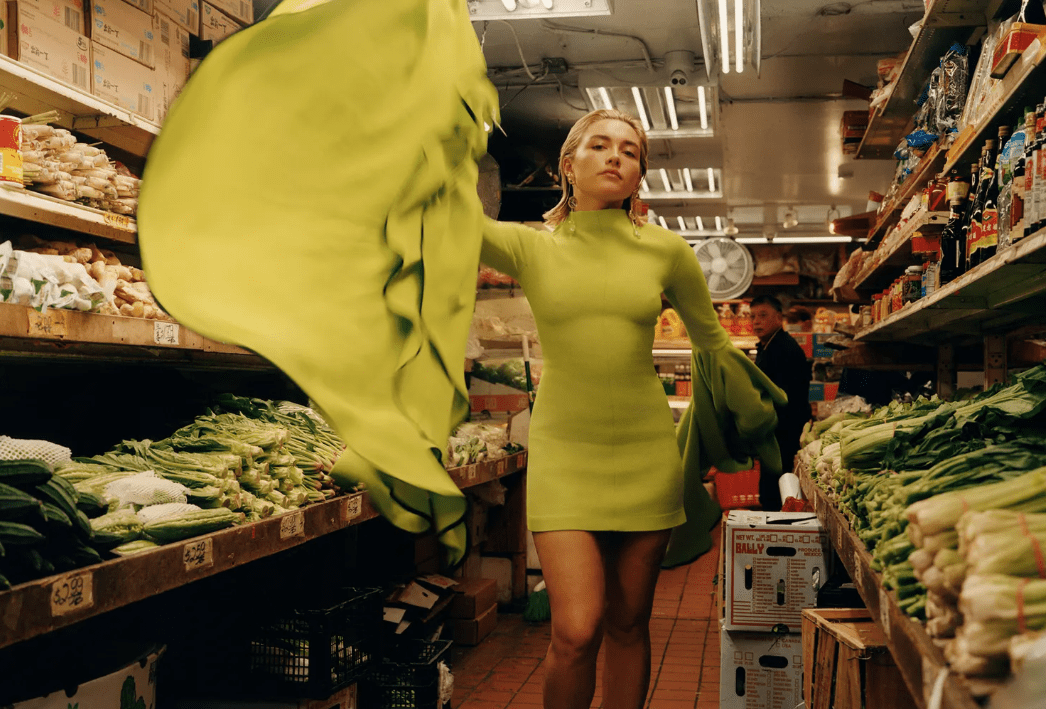
In a cinematic era increasingly shaped by algorithms, franchises, and fleeting virality, Florence Pugh feels almost defiantly human. Her rise has not been engineered through spectacle alone, but forged through something far more enduring: instinct, risk, and an unshakable sense of self. At just the beginning of what promises to be a decades-spanning career, Pugh has already done something rare—she has made authenticity not just her image, but her currency.
And in today’s culture, that might be the most radical performance of all.
A Star Who Refuses to Perform Stardom
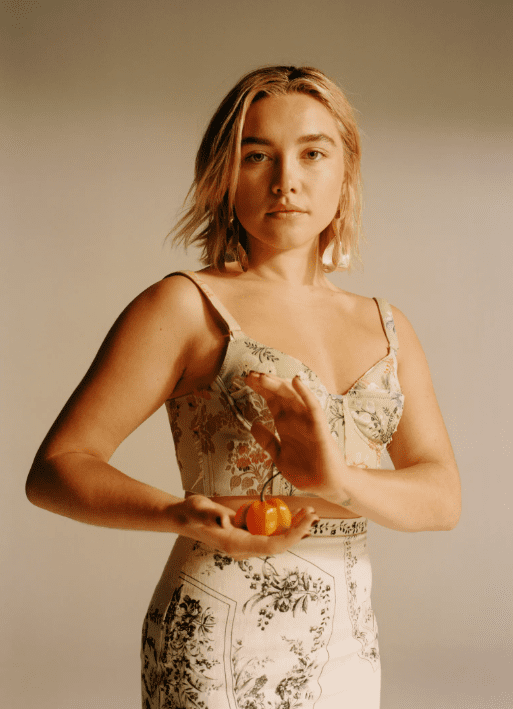
Pugh’s magnetism begins with contradiction. She is both precise and unpolished, commanding yet disarmingly open. Whether she is crafting a devastating emotional arc in Midsommar or reshaping a once-dismissed literary character into something quietly revolutionary in Little Women, her performances carry a sense of immediacy—like they are unfolding rather than being executed.
There is no visible machinery behind her acting. No trace of over-calculation. It is this quality that has drawn inevitable comparisons to Kate Winslet—not as imitation, but as lineage. A kind of emotional fluency that transcends technique.
And yet, unlike many of her contemporaries, Pugh never followed a traditional path. Without formal drama school training, she developed a style rooted in instinct rather than doctrine. What could have been perceived as a limitation has instead become her greatest advantage: a rawness that cannot be taught, only lived.
The Architecture of a Modern Career
Pugh’s filmography reads less like a résumé and more like a carefully curated manifesto. From the austere brutality of Lady Macbeth to the operatic grief of Midsommar, she has consistently gravitated toward characters that are difficult, flawed, and often unsettlingly real.
But what sets her apart is not just the depth of her roles—it is the balance. In stepping into the global machinery of Black Widow, she introduced Yelena Belova with a wit and emotional sharpness that elevated the Marvel universe beyond its usual rhythms. It was not a departure from her indie roots, but an expansion of them.
This duality—art-house credibility paired with blockbuster visibility—has positioned her as one of the few actors capable of moving seamlessly between worlds. Collaborations with filmmakers like Greta Gerwig and Christopher Nolan further underscore her ability to exist at the intersection of artistry and scale, as seen in Oppenheimer and the sweeping cinematic universe of Dune: Part Two.
Radical Self-Acceptance in a Filtered World
If Pugh’s on-screen work is defined by emotional courage, her off-screen presence is marked by something equally powerful: refusal. Refusal to conform, to soften, to edit herself for comfort.
Her now-iconic stance on body image—whether through sheer couture moments or candid responses to online scrutiny—has positioned her at the forefront of a broader cultural conversation about autonomy and visibility. Where others might retreat, Pugh leans in, transforming criticism into confrontation.
“I’ve never been scared of what’s underneath the fabric,” she has said—a statement that encapsulates not just her approach to fashion, but to identity itself.
This ethos extends into her digital presence. Her “Cooking With Flo” videos—messy, joyful, unfiltered—offer a version of celebrity rarely seen: one that invites rather than performs. In an age of curated perfection, her willingness to be imperfect feels almost subversive.
The Emotional Intelligence of a Generation
What makes Pugh particularly resonant is not just her talent, but her emotional intelligence—her ability to navigate complexity without diluting it. Her characters are rarely likable in a traditional sense, yet they are deeply understood. She doesn’t ask audiences for approval; she asks for empathy.
Even in roles that flirt with darkness, there is an undercurrent of vulnerability that feels unmistakably human. It is this quality that transforms performances into experiences—moments that linger long after the credits roll.
Directors often speak of her as a force that reshapes the material itself. She doesn’t simply inhabit a script; she interrogates it, expands it, and, at times, transcends it.
Beyond the Screen
Away from the camera, Pugh’s world remains grounded in creativity that extends beyond acting. From music and cooking to design and storytelling, her artistic instincts are omnidirectional. She approaches life with the same curiosity she brings to her roles—a willingness to experiment, to fail, to begin again.
It is this sense of play, of “let’s-go gameness,” that defines her not just as an actor, but as a cultural figure. Someone who resists being flattened into a single narrative.
The Shape of What’s Next
With major projects like Thunderbolts on the horizon and an ever-expanding presence across global cinema, Pugh’s trajectory shows no signs of slowing. Yet what makes her future compelling is not its scale, but its unpredictability.
She is not chasing legacy. She is building it—role by role, choice by choice.
And perhaps that is why Florence Pugh feels so essential right now. In a world increasingly defined by artifice, she offers something refreshingly rare: a reminder that the most powerful thing an actor can be is real.







Comments are closed.