
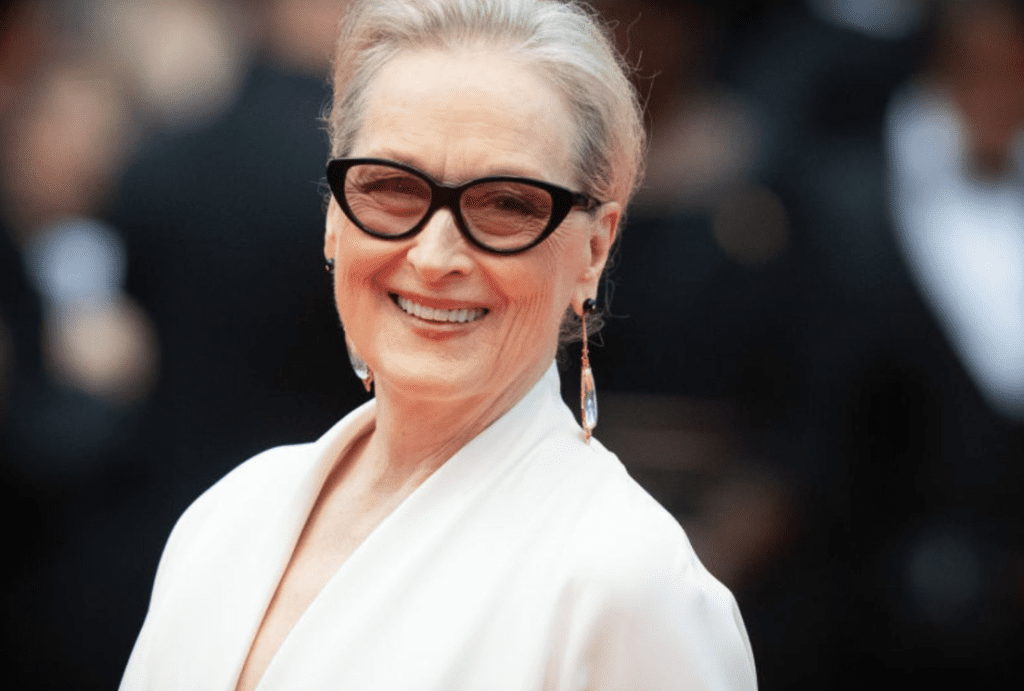
There are stars, there are icons—and then there is Meryl Streep, who exists in a category so singular it feels almost immune to comparison. In an industry obsessed with reinvention, she has quietly mastered something far more elusive: permanence. Not as a fixed persona, but as a living, breathing archive of human experience. For nearly half a century, Streep hasn’t simply acted—she has translated emotion, language, and identity into something universally understood, yet impossibly specific.
At a moment when Hollywood continues to renegotiate its relationship with age, gender, and legacy, Streep’s career feels less like a trajectory and more like a blueprint.
The Architecture of Excellence

To speak of Streep’s record-breaking career is to confront statistics that verge on myth. With over 21 Academy Award nominations—more than any actor in history—she has transformed the Academy Awards into something of a recurring stage. Yet numbers alone fail to capture what makes her extraordinary.
What distinguishes Streep is not merely her consistency, but her refusal to calcify into a type. In Sophie’s Choice, she delivered a performance so emotionally devastating it redefined the limits of cinematic grief. Decades later, she would pivot seamlessly into the icy, razor-sharp authority of Miranda Priestly in The Devil Wears Prada—a role that embedded itself into fashion and pop culture with startling permanence.

Between those two poles lies a career built on risk: the political gravitas of The Iron Lady, the buoyant musicality of Mamma Mia!, and the intimate realism of Kramer vs. Kramer, which earned her first Oscar. Each performance feels less like a variation and more like a complete disappearance.
The Discipline of Transformation
Much has been written about Streep’s technical precision—her near-mythical command of accents, her forensic attention to physicality—but to reduce her craft to technique is to miss the point. What she achieves is not imitation, but embodiment.
In The Deer Hunter, her restraint spoke louder than dialogue, while in The Iron Lady, she transformed Margaret Thatcher into a figure at once formidable and fragile. This duality—strength coexisting with vulnerability—has become her signature, though never her limitation.
Streep’s performances often feel as though they are happening in real time, unburdened by the machinery of acting. It’s a paradox: the more precise her preparation, the more invisible it becomes.
Rewriting the Narrative of Longevity
Perhaps Streep’s most radical contribution to cinema isn’t a single role, but the shape of her career itself. In an industry that has historically sidelined women past a certain age, she has not only remained relevant—she has expanded the definition of what relevance looks like.
Her performance in The Devil Wears Prada didn’t just dominate the box office; it reframed the mature woman as a cultural force—complex, powerful, and unapologetically central. At a time when Hollywood was still clinging to youth as its primary currency, Streep offered an alternative narrative: that experience, nuance, and authority could be just as compelling.
This is not longevity as survival. It is longevity as evolution.
The Industry’s Mirror
To watch Streep’s career is to watch the industry reflect on itself. Directors write differently for her. Co-stars recalibrate around her. Audiences arrive with expectation, but leave with something closer to reverence.
Her peers often describe her work as “effortless,” a word that, in this context, feels almost misleading. What appears effortless is, in reality, the result of decades of disciplined curiosity—a relentless commitment to understanding people in all their contradictions.
In an era increasingly driven by algorithms and virality, Streep remains defiantly analog: a reminder that great acting is not about spectacle, but about truth.
The Legacy of Presence
If greatness in acting is measured by transformation, then Streep has long since transcended the metric. She doesn’t simply disappear into roles—she elevates them, leaving behind characters that feel lived-in, textured, and enduring.
But perhaps her most lasting legacy is subtler. She has redefined what it means to sustain a career in Hollywood—not by chasing relevance, but by embodying it.
In the end, Streep’s genius lies not in becoming someone else, but in revealing, with startling clarity, who we are.









Comments are closed.