
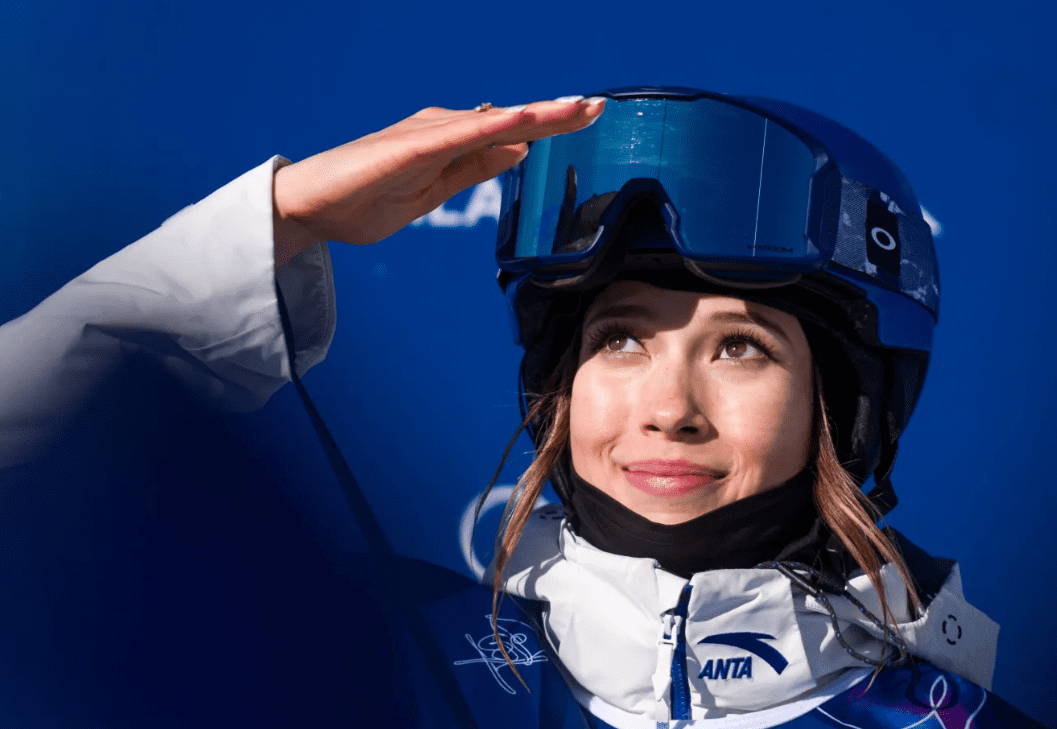
The Olympic champion with a Stanford mind, fashion-world influence, and global cultural impact is redefining what it means to be an athlete in the modern era.
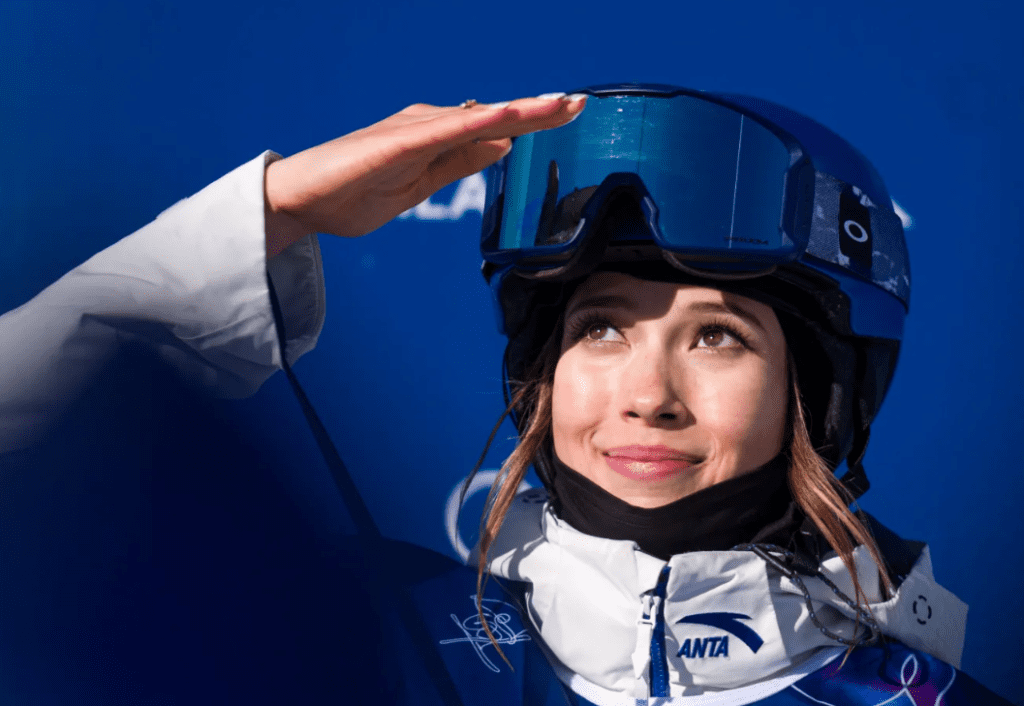
The Athlete Who Refused to Be Defined by Limits
On a quiet summer training day in the Austrian Alps, something becomes immediately clear about Eileen Gu.
While other freestyle skiers joke around between jumps, filming social media clips and blasting music, Gu approaches the slope like a laboratory. Each landing is followed by analysis. Each movement becomes a study in physics.
It’s not unusual to hear her discussing concepts like angular momentum, motor-neuron activation, or axis rotation — vocabulary that feels more appropriate inside a university lecture hall than a ski park.
But that’s precisely the point.
Gu is not simply training for the next competition. She is dissecting it.
“I don’t believe in limits,” she says matter-of-factly.
For the 22-year-old superstar, the philosophy is more than motivational rhetoric. It has become the foundation of one of the most fascinating careers in modern sports.
A Global Star Born on Olympic Snow
Gu’s rise to international fame exploded during the 2022 Winter Olympics in Beijing.
Competing in freestyle skiing, she delivered one of the most memorable performances in Olympic history. She captured:
- Gold in Big Air
- Gold in Halfpipe
- Silver in Slopestyle
The achievement made her the first action-sports athlete ever to win three medals in a single Olympic Games.
Yet the moment that cemented her legend came during the final run of the Big Air competition.
Facing enormous pressure, Gu attempted a double cork 1620 — a trick involving four and a half spins while rotating off-axis twice.
It was a maneuver she had never successfully performed in competition before.
When she landed it perfectly, the stadium erupted.
In that instant, Gu transformed from promising athlete into global icon.
The Athlete Who Lives in Multiple Worlds
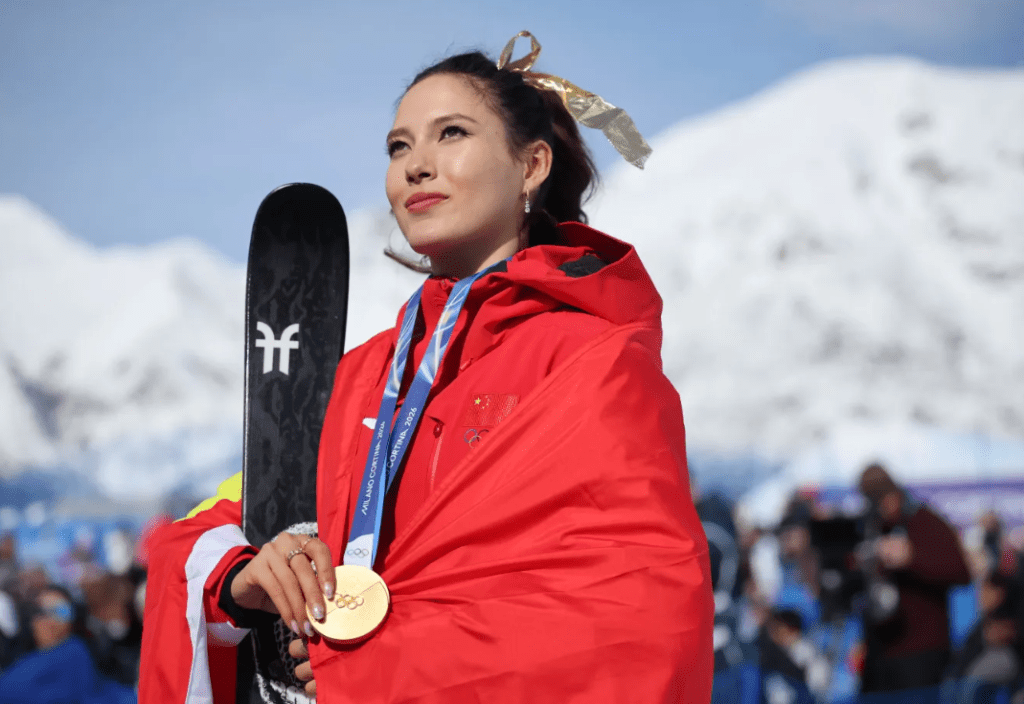
Unlike most sports stars, Gu refuses to exist in a single lane.
While dominating freestyle skiing competitions, she simultaneously built an unusually diverse life that spans continents and industries.
She is:
- A student at Stanford University studying international relations and physics
- A fashion model walking runways for luxury houses like Louis Vuitton
- A global ambassador for brands including Red Bull, Tiffany & Co., and Porsche
- One of the most recognizable athletes in Asia
In China, her popularity borders on phenomenon. Fans wave flags bearing her name, and crowds gather wherever she appears.
The level of celebrity rivals pop stars.
Yet Gu herself insists she sees things differently.
“I’m a full-time student who’s really athletic,” she says.
And in many ways, that perspective defines her.
The Decision That Sparked Global Debate
Gu’s career, however, has never been free of controversy.
Born and raised in California to an American father and Chinese mother, she made a decision in 2019 that ignited international debate: she chose to represent China in international competitions.
For some critics in the United States, the move felt like betrayal.
For some commentators in China, she was still viewed as an outsider.
Suddenly, a teenage skier became an unexpected symbol within the geopolitical tensions between two global powers.
The attention was overwhelming.
And yet Gu refused to let the narrative define her.

“The U.S. already has representation,” she explained. “I wanted to help build something new.”
Fame, Pressure, and the Hidden Cost of Olympic Glory
Behind the scenes, Gu faced challenges rarely discussed in the glamorous world of sports.
Following the Beijing Olympics, she experienced the emotional crash that many elite athletes describe after reaching the pinnacle of their careers.
Olympic legends like Michael Phelps have spoken publicly about the phenomenon known as post-Olympic depression — the psychological void that can follow the most intense competition of a lifetime.
Gu discovered that success does not shield anyone from it.
In quiet moments after the Games, surrounded by billboards featuring her own image, she began questioning whether she had already reached the peak of her life at just 18.
“I felt like I was living in the shadow of my past,” she later admitted.
The experience forced her to rethink everything — from ambition to identity.
Reinvention Before the Next Olympics
Four years later, Gu appears transformed.
She has traveled the world, experimented with new experiences, and expanded her identity beyond competition.
Fashion shows in Paris. Academic lectures at Stanford. Cultural events across Asia.
She describes the period as “data collection.”
Instead of chasing validation, she began asking a different question:
What does she actually want?
The answer brought her back to skiing.
But this time, it wasn’t about proving anything.
It was about choosing it.
The Road to the 2026 Winter Olympics
As the sporting world prepares for the 2026 Winter Olympics in Milan and Cortina d’Ampezzo, Gu enters a rare position.
She is no longer just a champion defending titles.
She is the face of an entire sport.
Her medal count continues to grow, including multiple Freeski World Cup victories, reinforcing her reputation as one of the greatest freestyle skiers in history.
But the true challenge ahead is psychological.
Winning once is extraordinary.
Winning again is legendary.
The Modern Definition of an Icon
What makes Eileen Gu remarkable is not simply the medals.
It’s the way she represents a new generation of global figures.
Athletes are no longer confined to stadiums.
Models are no longer confined to fashion.
Students are no longer confined to classrooms.
Gu exists at the intersection of all three.
In a world obsessed with specialization, she embodies something radical:
multidimensional excellence.
And as the world watches the next Olympic Games unfold, one thing feels certain.
If Gu lands her next impossible trick, it won’t simply be another victory.
It will be another chapter in the story of an icon who refuses limits.










Comments are closed.