
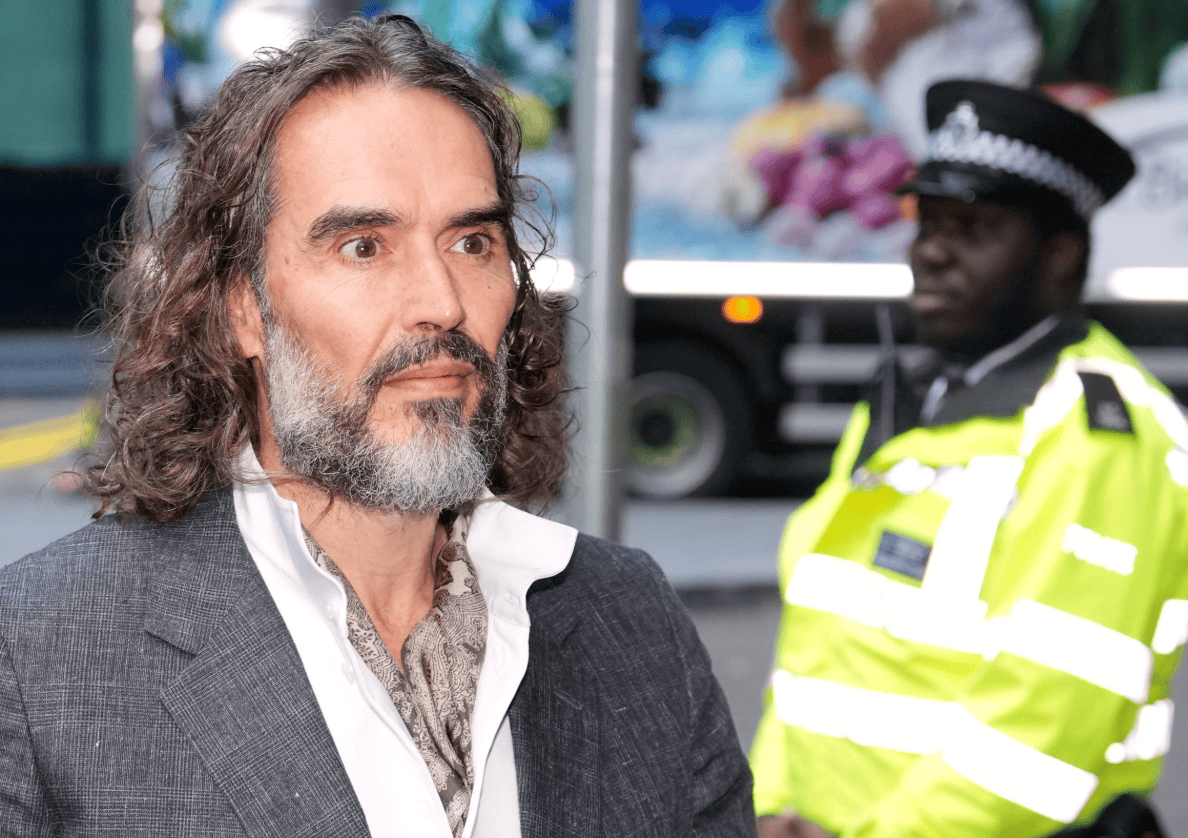
The Russell Brand trial opened at Southwark Crown Court on 14 October 2026, bringing renewed attention to allegations of sexual offences dating back more than two decades. The comedian and actor, now 51, faces seven charges involving six women, all of which he denies. The prosecution has begun outlining its case, while the trial will determine whether the allegations are proved in court.
The proceedings mark a significant legal development in a case involving alleged incidents between 1999 and 2009, a period when Brand’s career was developing from stand-up comedy towards television and film. Prosecutors say the women came forward independently and did not know one another. Their accounts will now be examined through the criminal justice process.
Russell Brand Trial: What Are the Charges?
Brand faces three counts of rape, three counts of sexual assault and one count of indecent assault. The allegations relate to six women and span several years, with incidents said to have occurred in locations including a hotel room, a workplace, a London bar and a private residence.
Brand has pleaded not guilty to all seven charges. His denial means the prosecution must present evidence to establish the allegations to the criminal standard of proof. The charges remain allegations unless and until they are proved in court.
Prosecutor Riel Karmy-Jones KC opened the case by outlining the prosecution’s account of the alleged conduct. She told jurors that the six women had come forward independently and described a pattern of behaviour that, according to the prosecution, continued as Brand’s public profile grew.
The defence will have the opportunity to challenge the prosecution’s evidence, question witnesses and present its own case as the trial progresses.
What the Prosecution Told the Jury
In her opening address, Karmy-Jones characterised Brand as someone who allegedly expected his sexual desires to be satisfied regardless of the wishes of the women involved. She described him as manipulative and entitled, arguing that the allegations reflected conduct across a decade of his early career.
These descriptions represent the prosecution’s position, not findings established by the court. The jury must assess the evidence presented during the proceedings and decide whether the individual charges have been proved.
The prosecutor also referred to statements attributed to people who knew Brand during his earlier years. Their accounts were presented as background to the prosecution’s argument about his behaviour before and during his rise to prominence.
Allegations Dating From 1999 to 2005
The first allegation concerns an incident said to have occurred in Bournemouth in 1999, during a Labour Party conference. Prosecutors allege that a woman met Brand at an event and later encountered him in a hotel room, where the alleged rape took place.
A second allegation relates to 2001 and involves a woman who worked for MTV. The prosecution says Brand tried to persuade her to enter a men’s toilet with him and grabbed her arm when she resisted. She allegedly managed to pull away.
Two further allegations concern incidents in London in 2004 and 2004 or 2005. In the first, prosecutors allege that Brand grabbed a woman’s breasts and subsequently forced her into a toilet, where an oral rape occurred. In the other, a woman working at a radio station allegedly experienced an unwanted physical and sexual encounter in which Brand pushed her against a wall and kissed her aggressively.
The court will consider the evidence relating to each allegation separately, including the accounts given by the complainants and any challenges raised by the defence.
The Two Allegations From 2009
The final two complainants describe alleged incidents in 2009.
The fifth woman met Brand after attending a performance at London’s Hammersmith Apollo, according to the prosecution. The court heard that their encounter initially involved consensual sexual activity. Prosecutors allege that a subsequent sexual act became non-consensual and continued despite her requests for Brand to stop.
The sixth allegation relates to a woman working on a professional assignment. Prosecutors say Brand demanded a massage and placed his head against her groin area, leaving her feeling uncomfortable and unable to react immediately.
The prosecution also told jurors about the women’s reported experiences following the alleged incidents, including distress, anxiety and self-blame. These accounts form part of the case being presented to the court.
Brand’s Response to the Allegations
Brand has denied all the charges. According to the prosecution’s opening account, he previously provided police with a prepared statement rejecting allegations of non-consensual sexual activity.
The statement reportedly argued that accounts of his behaviour had been reinvented or imagined following a documentary and subsequent media coverage. Brand’s position will be considered alongside the evidence presented at trial.
When he arrived at Southwark Crown Court on 14 October, Brand told reporters that he felt concerned but hopeful that the proceedings would lead to good outcomes for everyone involved.
His comments came as photographers and journalists gathered outside the court for the opening day. The case has attracted substantial public attention because of Brand’s celebrity status and the seriousness of the charges.
However, public statements, previous reporting and commentary about a defendant cannot replace the legal process. The jury must base its verdict on the evidence and the judge’s directions.
Why the Trial Matters
The Russell Brand trial raises important questions about accountability, consent and the handling of allegations involving public figures. It also illustrates the challenges of examining alleged offences many years after they are said to have occurred.
The incidents outlined by prosecutors date from 1999 to 2009. Establishing what happened during that period may require jurors to assess witness testimony, the circumstances surrounding each alleged incident and any available supporting evidence.
The passage of time can complicate investigations. Memories may be difficult to reconstruct, records may no longer exist, and witnesses may recall events differently. At the same time, the age of an allegation does not, by itself, establish whether it is true or false.
The trial will therefore require careful consideration of the evidence relating to each charge rather than assumptions based on Brand’s reputation or the volume of media coverage.
The Importance of Due Process
Sexual offence cases demand a balance between taking complainants’ accounts seriously and protecting the defendant’s right to a fair trial. Both principles are essential to the administration of justice.
The six women who brought the allegations are entitled to lifelong anonymity under the applicable legal protections. Responsible reporting must respect those protections while accurately describing the proceedings.
Equally, Brand remains entitled to the presumption of innocence unless the charges are proved. Allegations made in court must be distinguished clearly from established facts, particularly when coverage reaches a large audience through live blogs and social media.
These safeguards are not merely procedural details. They help ensure that the court can assess the evidence without substituting public opinion for a verdict.
What Happens Next in the Russell Brand Trial?
The prosecution’s opening statement has set out the broad allegations and the case it intends to present. As proceedings continue, jurors are expected to hear evidence relevant to the individual charges, allowing them to evaluate the complainants’ accounts and the defence’s responses.
The trial is expected to last up to six weeks, according to the reporting available on its opening day. Its outcome will depend on the evidence heard in court, not on predictions made before the proceedings conclude.
For readers following the case, the most important distinction is between an allegation, evidence presented to support it and a judicial finding. These are different stages of the legal process and should not be treated as interchangeable.
Conclusion
The Russell Brand trial began on 14 October 2026, with prosecutors outlining seven sexual offence charges involving six women and alleged incidents spanning a decade. Brand has pleaded not guilty to every charge, and the jury must determine whether the prosecution has proved its case.
As the proceedings continue, accurate reporting will be essential. The trial deserves close scrutiny because of the seriousness of the allegations, but its conclusions must rest on the evidence and the principles of a fair criminal process. Further developments should be assessed in that context as the court works towards a verdict.








Comments are closed.