


Why the Internet Keeps Linking a Psychological Thriller to Epstein — and What That Says About Power, Memory, and Media Control
When Zoë Kravitz released Blink Twice, it arrived framed as a bold debut: a slick, unsettling psychological thriller about wealth, gendered power, and erasure.
Two years later, the film has escaped its original category.
In early 2026, Blink Twice re-entered public conversation not because of awards or retrospectives, but because audiences began drawing persistent, uncomfortable comparisons between its fictional billionaire island and the real-world crimes associated with Jeffrey Epstein.
What began as metaphor is now being interrogated as mirror.
The Island as a System, Not a Setting
At the heart of Blink Twice lies a familiar but potent structure:
a private island, absolute wealth, controlled access, confiscated phones, lavish indulgence — and women who wake up with bruises they cannot remember earning.
In isolation, these are recognizable thriller tropes. But history has charged them with meaning.
Epstein’s private island in the U.S. Virgin Islands became a global symbol of how extreme wealth creates closed ecosystems, where abuse can occur beyond scrutiny, accountability, or consequence. Survivors described environments engineered to confuse, disorient, and silence — not always through overt force, but through control, routine, and dependency.
Kravitz’s island functions the same way. It is not just a place. It is a mechanism.
Memory Loss as Power Infrastructure
The most disturbing parallel audiences point to is not location, but method.
In Blink Twice, women are subjected to memory erasure via a perfume derived from island flowers. Forgetting becomes policy. Trauma becomes deniable. Consent becomes irrelevant.
Online discourse intensified in 2026 after renewed attention to Epstein-related emails referencing “trumpet plants” and scopolamine — a real compound known, in high doses, to cause confusion, suggestibility, and memory impairment. While there is no evidence that such substances were used in Epstein’s crimes, the symbolic overlap proved combustible.
The reaction wasn’t: this is the same.
It was: why does this feel so close?
That distinction matters.
What Kravitz Did — And Did Not — Claim
Zoë Kravitz has never stated that Blink Twice is based on Epstein or any specific individual. The film was conceived years earlier as a commentary on elite male entitlement, complicity, and how abuse hides in plain sight.
Yet what gives the comparison weight is not intent — it is structure.
Both the film and real-world cases describe environments where:
- wealth shields behavior
- isolation removes witnesses
- pleasure masks coercion
- and forgetting — literal or social — becomes the final safeguard
This is not coincidence so much as pattern recognition.
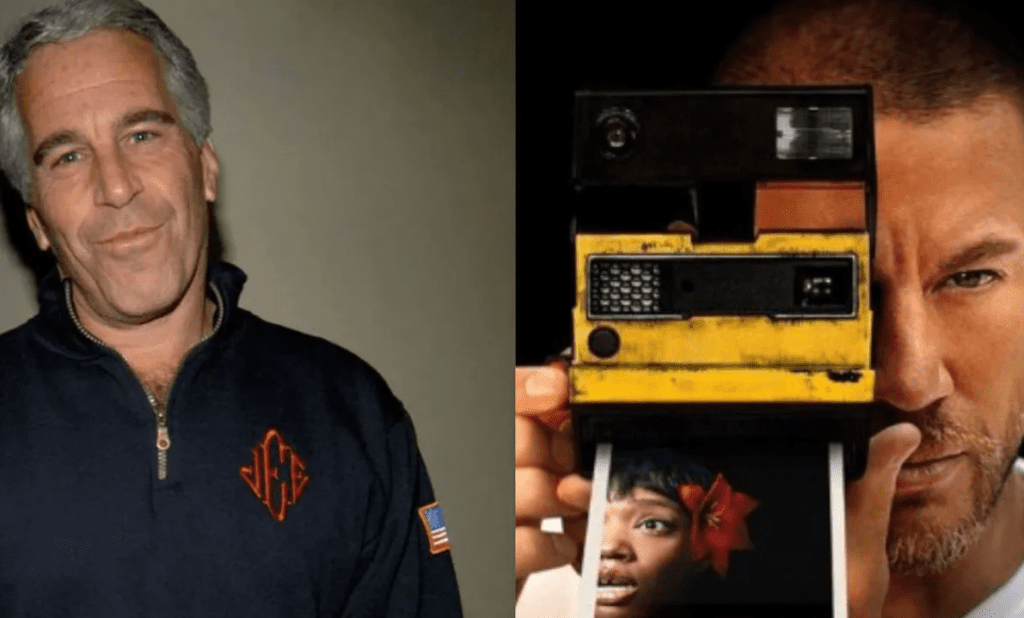
The Internet’s Role: Amplifier or Distorter?
Social media has treated Blink Twice less like cinema and more like evidence. Some posts frame it as exposé. Others as coded confession. That leap is dangerous — and revealing.
We are living in a moment where trust in institutions is eroded, official narratives feel incomplete, and culture turns to art to fill in the blanks. Films become emotional truth-holders when legal truth feels inaccessible.
But there is a risk here.
Turning art into accusation flattens its meaning and undermines survivors by replacing facts with speculation. At the same time, dismissing audience reaction entirely ignores why these connections resonate so deeply.
The discomfort is real — even if the conclusions are not always sound.
Media Manipulation: On Screen and Off
Ironically, Blink Twice is now experiencing the very phenomenon it critiques.
The film exposes how reality can be edited, softened, and reframed until victims doubt themselves. Its reception is unfolding inside a media ecosystem that does the same — privileging virality over nuance, outrage over care.
Headlines blur fiction and fact. Algorithms reward shock. Context collapses.
And yet, Kravitz’s film survives this distortion precisely because it never relied on explicit reference. It speaks in systems, not names.
Why the Epstein Comparison Won’t Go Away
The comparison persists because Epstein’s case permanently altered public understanding of power. It taught audiences that:
- abuse can be institutional
- silence can be engineered
- and luxury can function as camouflage
Any story involving a billionaire, a private island, and erased memory now exists in that shadow.
Blink Twice didn’t create the association. History did.
A Film That Arrived Before Its Moment — And Found It Later
In 2024, Blink Twice unsettled audiences.
In 2026, it unsettles culture.
Not because it reveals hidden facts, but because it articulates a truth many already sense: that abuse within elite spaces rarely looks violent at first. It looks curated. Polite. Forgettable.
Zoë Kravitz didn’t make a film about Epstein.
She made a film about how systems like his survive.
Final Reflection
The danger is not that audiences see Epstein in Blink Twice.
The danger would be pretending the resemblance is meaningless.
Art does not need to accuse to indict. Sometimes it only needs to map the terrain — and trust the viewer to recognize it.
In that sense, Blink Twice has become more than a debut.
It is a cultural document of suspicion, memory, and reckoning.
And once seen through that lens, it is impossible to unsee.











Comments are closed.