
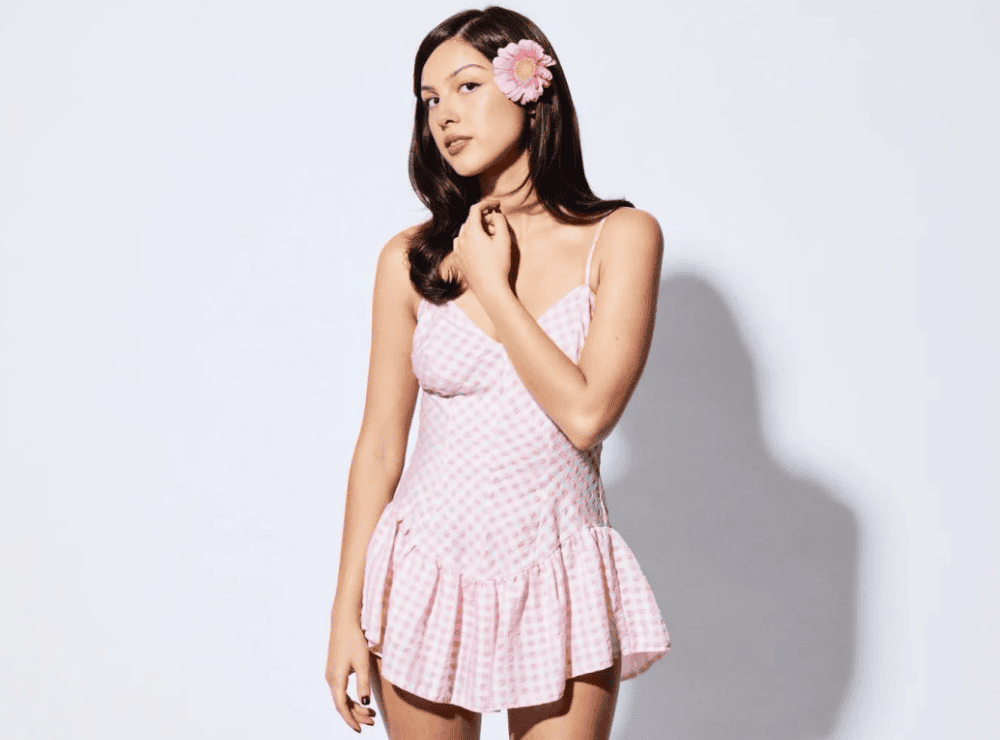
There was a time when Olivia Rodrigo’s biggest achievement seemed almost impossible to imagine.
A teenager writes a heartbreak song. The song goes viral. Suddenly, she is one of the biggest young artists in the world.
But that was only the beginning.
Five years after drivers license changed her life, Rodrigo has grown into something much more interesting than a pop star. She has become a songwriter, performer, fashion figure and cultural voice — and, increasingly, someone determined to use her influence for something bigger than herself.
August 2026 offered perhaps the clearest example yet.
With the launch of Daisy Chain Fields, Rodrigo didn’t simply headline another festival. She created one.
And by the time the inaugural event took place on August 29 at Great Park in Irvine, California, it had already raised $10 million for nonprofit organizations supporting women and girls.
That is why Olivia Rodrigo feels like the right choice for Iconic Times’ Icon of the Month.
The Girl Who Changed Pop
Olivia Rodrigo’s rise remains one of the defining pop stories of the 2020s.
When drivers license arrived in January 2021, it became more than a hit. It became a cultural moment.
The song’s emotional directness was part of its power. Rodrigo wasn’t singing about heartbreak from a distance. She sounded like someone experiencing it in real time — confused, hurt, jealous and vulnerable.
Millions of listeners recognized themselves in it.
Her debut album, SOUR, turned that connection into a global career, earning her three Grammy Awards and establishing her as one of the most compelling young songwriters in contemporary pop.
Then came GUTS, which showed that she wasn’t interested in simply recreating the success of her debut.
The sound became louder. The guitars became sharper. The emotions became messier.
Rodrigo was growing up — and allowing her audience to grow with her.
A New Era in 2026
This year has brought another major chapter.
Rodrigo released her third studio album, you seem pretty sad for a girl so in love, in June, continuing her evolution as a songwriter while retaining the emotional honesty that has become her trademark.
The album’s arrival marked another reminder that Rodrigo’s greatest strength isn’t simply her ability to create hits.
It’s her ability to make complicated feelings sound universal.
Her songs can move between heartbreak, desire, insecurity, confidence and anger without losing their intimacy.
Even as the scale of her career has become enormous, the emotional distance between artist and listener remains surprisingly small.
Then She Built Daisy Chain Fields
If Rodrigo’s music established her voice, Daisy Chain Fields demonstrated what she intends to do with it.
The inaugural festival took place on August 29, 2026, at Great Park in Irvine, bringing together an extraordinary lineup of women artists across generations.
The lineup included Rodrigo alongside Chappell Roan, Doechii, Mitski, Bikini Kill, Garbage, The Breeders, Santigold, Rachel Chinouriri, Die Spitz, Eli, Quiet Light and Not for Radio, with special appearances from Stevie Nicks, Sarah McLachlan and Karen O.
Rather than creating a festival based around competition, Rodrigo envisioned something more collaborative.
The concept was influenced by the history of women-led music festivals, particularly Lilith Fair, founded by Sarah McLachlan in the 1990s.
For Rodrigo, the women who built those spaces before her proved that female artists didn’t have to wait for permission.
Daisy Chain Fields was her opportunity to continue that tradition.
The $10 Million Moment
The most important number connected to Daisy Chain Fields isn’t the attendance, the number of performers or the size of the stage.
It’s $10 million.
On August 28, ahead of the festival, Rodrigo announced that the event had generated $10 million in donations for nonprofits supporting women and girls. The money is being distributed across 10 organizations working in areas including reproductive healthcare, maternal health, gender justice, support for domestic workers and assistance for survivors of gender-based violence.
The beneficiaries include organizations such as Baby2Baby, Black Mamas Matter Alliance, the Center for Reproductive Rights, FreeFrom, Jhpiego, Johns Hopkins Center for Indigenous Health, the National Domestic Workers Alliance, the National Institute for Reproductive Health, the National Women’s Law Center and Planned Parenthood.
It gives the festival a significance that extends far beyond one day of live music.
The stage was temporary.
The impact doesn’t have to be.
A Festival Inspired by the Women Who Came Before
One of the most meaningful elements of Daisy Chain Fields was its connection to music history.
Rodrigo has openly credited the women behind Lilith Fair for helping make events like hers possible.
The comparison is important.
Lilith Fair challenged the music industry’s assumptions about female artists in the 1990s, proving that audiences would show up for festivals built around women.
Decades later, Rodrigo is taking that idea into a new generation.
And she isn’t pretending she invented the movement.
She is acknowledging the women who made the path wider.
That sense of continuity gives Daisy Chain Fields something that many new festivals lack: history.
When Pop Stardom Becomes Responsibility
There is a difference between being famous and knowing what to do with fame.
Rodrigo’s career has increasingly moved toward the second.
Her activism and advocacy around women’s health and reproductive rights have become an important part of her public identity, and Daisy Chain Fields brought those interests directly into her work as an artist.
The festival was designed not only as a concert but as a space where music, community and advocacy could exist together.
That idea feels particularly significant in 2026.
At a moment when conversations around women’s rights, healthcare access and equality remain deeply contested, Rodrigo has chosen to use one of the most powerful tools available to a pop star — attention.
And she has directed it toward organizations already doing the work.
The Olivia Rodrigo Effect
Rodrigo’s influence is also visible in fashion.
Her style has become closely associated with a modern interpretation of teenage nostalgia: vintage references, punk influences, mini skirts, graphic pieces, playful accessories and a deliberately imperfect edge.
It mirrors her music.
Nothing feels too polished.
There is always a little rebellion.
A little vulnerability.
A little chaos.
That authenticity has made Rodrigo particularly influential among younger audiences, where personal style and music culture increasingly overlap.
She isn’t simply participating in trends.
She is helping define the visual language of her generation.
Still Young, Already Iconic
Perhaps the most remarkable thing about Olivia Rodrigo’s story is how early she has achieved all of this.
She is still only 23.
Yet she has already experienced the kind of career trajectory that many artists spend decades pursuing: global hits, Grammy Awards, major tours, cultural influence and now her own music festival.
But Daisy Chain Fields suggests that her ambitions are changing.
The question is no longer:
How big can Olivia Rodrigo become?
It’s:
What can Olivia Rodrigo build?
That is a much more interesting question.
Why Olivia Rodrigo Is August’s Icon
Olivia Rodrigo represents a new kind of pop icon.
She doesn’t need to appear untouchable.
She doesn’t need to manufacture controversy.
She doesn’t need to constantly remind the world that she is famous.
Her influence comes from something more enduring: connection.
She writes about feelings people recognize.
She creates music that becomes part of people’s memories.
She dresses in ways that inspire imitation.
And now, she is creating spaces where other women can be heard.
Daisy Chain Fields is the clearest expression yet of that evolution.
The August Verdict
Olivia Rodrigo began her career by giving a generation a soundtrack for heartbreak.
In 2026, she’s doing something bigger.
She’s building community.
She’s supporting women and girls.
She’s celebrating the artists who came before her while creating opportunities for the ones coming next.
And she has shown that a music festival can be more than a collection of performances.
It can be a statement.
It can be a gathering.
It can be a platform.
It can raise $10 million and turn a pop star’s influence into tangible support for people who need it.
That is why, on the final day of August, Olivia Rodrigo isn’t simply one of pop’s biggest stars.
She is Iconic Times’ Icon of the Month.
Because the most powerful thing about Olivia Rodrigo today isn’t how loudly she can sing.
It’s how many other voices she is helping make louder.



Comments are closed.