
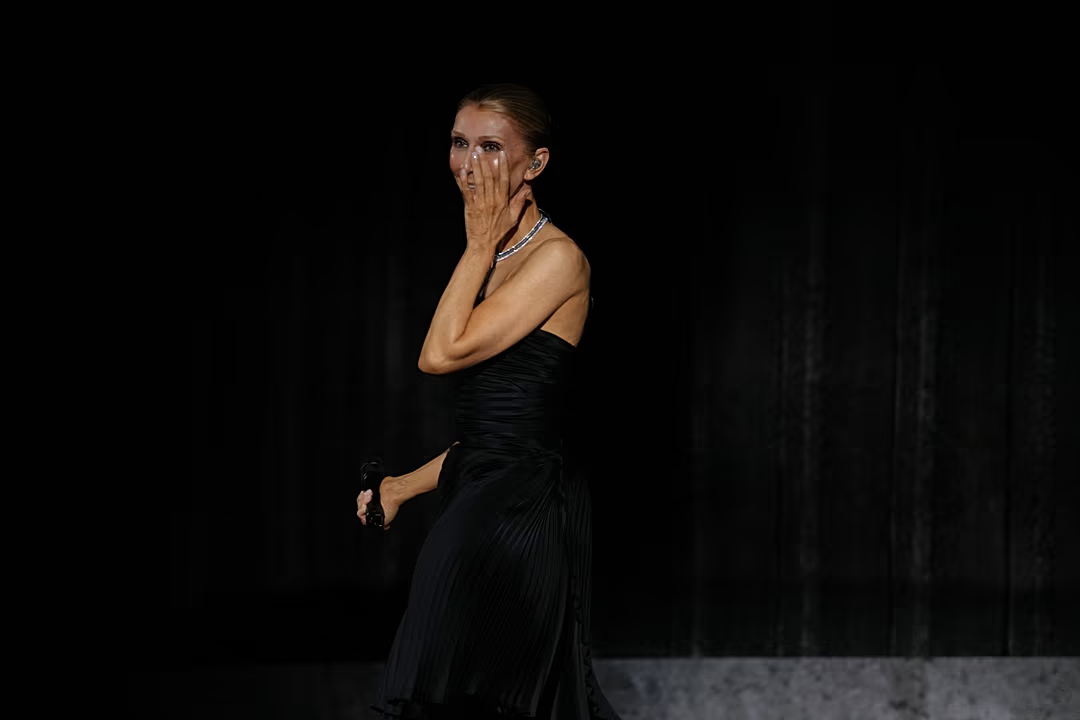
For six years, the stage remained out of reach for Céline Dion. On Saturday night in Paris, however, the silence finally broke.
In front of 30,000 fans at the Plenitude Arena in Nanterre, the Canadian singer made her long-awaited return to live performance, opening a 26-night residency with an emotional concert that felt less like a comeback than a declaration of survival.
Dion wept as she stepped before the audience, acknowledging the difficult road that had kept her away from the spotlight. In 2022, she revealed that she had been diagnosed with stiff person syndrome, a rare neurological autoimmune disorder that causes muscle stiffness and painful spasms. The condition forced her to cancel performances and raised an unsettling question for millions of fans: would they ever see her perform again?
On Saturday, Dion answered that question herself.
“The path was rocky, the journey took longer than expected,” she told the crowd, describing how she had been drawn toward “a faint beam of light in the distance, deep in the mountains.”
“Tonight, I want to sing for you. To sing for myself. To sing for life,” she added, met by a wave of cheers.
It was a statement that captured the emotional weight of the evening. This was not simply a major pop star returning to work. It was an artist reclaiming a part of her identity after years shaped by uncertainty, illness and the limits of her own body.
Dion went on to perform some of the songs that helped define her extraordinary career, including “My Heart Will Go On” and “Because You Loved Me.” The familiar melodies carried a new emotional dimension, transformed by the knowledge of everything she had endured to sing them again.
The performance reportedly drew praise from both fans and critics, while the audience included prominent figures such as former United States First Lady Michelle Obama and several French politicians.
The Paris residency, held at the arena formerly known as La Défense Arena, marks the beginning of 26 scheduled nights for Dion. It also represents a significant moment in her ongoing relationship with performance. For an artist whose voice has become synonymous with emotional intensity and technical power, returning to the stage required more than professional preparation. It demanded courage, patience and a willingness to perform within new physical realities.
Stiff person syndrome is incurable and can cause severe muscle stiffness and spasms. Dion’s diagnosis dramatically altered her career plans, making public appearances and live performances increasingly difficult. Yet her return suggests that the future of her artistry may not be defined by what the illness has taken away, but by what she continues to find possible.
Her comeback was also celebrated by Canadian Prime Minister Mark Carney, who congratulated her on social media, calling it “an incredible return to the stage after six long years.”
“It’s all coming back,” he wrote.
The phrase carried a particular resonance. Dion’s return was not about recreating the past exactly as it had been. Instead, it was about bringing the past forward into a different chapter, one shaped by experience and a deeper understanding of vulnerability.
For decades, Dion’s public image has been built around vocal strength, discipline and extraordinary endurance. Her performances have often demanded physical and emotional commitment on a monumental scale. This time, the strength was visible in a different form: in the decision to stand before an audience after years of uncertainty, and to sing not because the journey had been easy, but because the desire to perform had survived it.
There is something profoundly moving about an artist returning to the place where she once seemed most powerful, only to reveal that power now means something more complicated. It is no longer simply the ability to reach the highest note or command the largest room. It is the ability to continue creating while acknowledging limitation, to remain connected to an audience without pretending that nothing has changed.
Dion’s Paris comeback therefore belongs to a larger cultural conversation about illness, identity and the pressure placed on performers to remain endlessly available. Her return does not erase the seriousness of her condition, nor does it suggest that recovery follows a simple or predictable path. Instead, it offers a more honest image of resilience: one that allows for fear, delay, tears and uncertainty.
When she sang her most celebrated hits on Saturday night, the songs were instantly recognizable. But the woman singing them had travelled a very different road.
After six years away, Céline Dion was back on stage. More than a return to music, it was a return to possibility.
And for one extraordinary Paris evening, she sang for her audience, for herself and for life.







Comments are closed.