
When a Face Becomes a Cultural Event
There are moments in pop culture when resemblance stops being a casual observation and becomes something closer to a collective fixation. Noticing a family likeness is ordinary; pausing the internet over it is not.
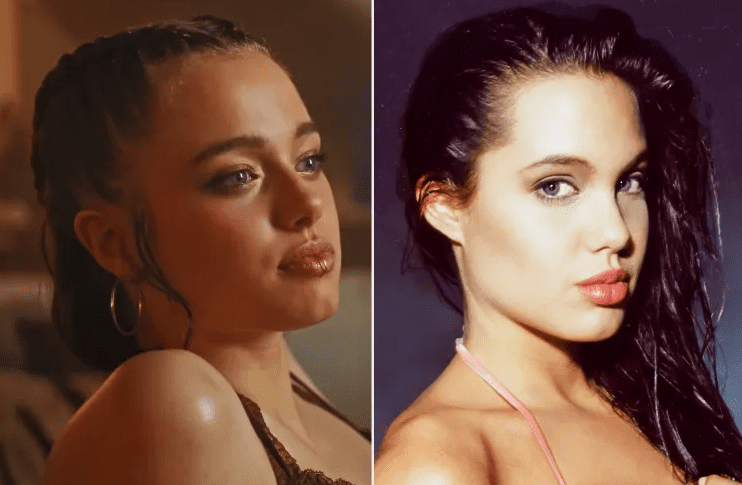
That is precisely what happened when Shiloh Jolie, 19, appeared in a teaser for South Korean artist Dayoung’s music video “What’s a Girl to Do.” Within seconds of the clip circulating, viewers weren’t discussing choreography or concept — they were seeing Angelina Jolie. Or more accurately, seeing the past reappear in motion.
In an entertainment landscape obsessed with lineage, legacy, and “nepo baby” discourse, Shiloh’s moment didn’t feel like a debut. It felt like a mirror held up to Hollywood history.
A Viral Casting That Wasn’t Supposed to Be Viral
The teaser itself is deceptively understated. Shiloh appears in a stylized dance sequence, dressed in a brown lace crop top, hair braided neatly, her look sharpened with subtle cat-eye makeup and a metallic lip ring. It’s a visual language rooted in contemporary K-pop aesthetics — precise, expressive, and tightly choreographed.
What transformed the clip into a global talking point, however, wasn’t the production. It was recognition.
Fans immediately connected her presence to Angelina Jolie’s early modeling era in the 1990s — the same bone structure, the same piercing gaze, the same almost cinematic stillness that once defined Jolie before she became an archetype of Hollywood stardom.
Within hours, social media threads and comment sections were filled with the same refrain: she doesn’t just resemble her mother — she replays her.
The Internet’s Obsession With Genetic Echoes
Celebrity culture has always been fascinated with inheritance, but the Jolie–Shiloh comparison hits a more specific nerve. It collapses time.
Angelina Jolie, once the embodiment of early-2000s Hollywood intensity, is now being visually “recast” through her daughter in real time. The effect is less about novelty and more about continuity — a reminder that fame does not end with one generation; it mutates.
Shiloh, however, is not positioned as a passive reflection. Her presence in a professional dance context suggests something more deliberate: an emerging identity shaped through movement rather than inheritance alone.
Still, the internet rarely allows nuance to survive untouched. The discourse oscillates between admiration and projection — between celebrating her talent and framing her as a genetic inevitability.
Dance as a Language, Not a Comparison
Beyond the viral comparisons, Shiloh’s trajectory has been quietly consistent within dance circles. Reports from choreographers and studio collaborators describe a performer committed to discipline rather than spectacle — someone building skill in environments far removed from Hollywood’s red carpets.
Her appearance in Dayoung’s project reportedly came through an open audition process in the United States, a detail that subtly complicates the narrative of privilege often attached to celebrity children. According to production representatives, her casting was not influenced by her family background, and her identity was not initially recognized.
In that framing, the story shifts. What looks like a celebrity cameo becomes something closer to a professional selection — a reminder that even within fame-adjacent spaces, craft can still function as currency.
The Jolie Legacy: Fame, Distance, and Reinvention
Shiloh’s public identity has long existed in a careful tension between visibility and withdrawal. The daughter of Angelina Jolie and Brad Pitt — two of the most globally recognized figures in modern cinema — she has grown up under a level of scrutiny few can imagine.
In recent years, she has also made quiet but significant personal decisions, including legally dropping “Pitt” from her surname after turning 18, a gesture widely interpreted as an assertion of autonomy rather than spectacle.
Meanwhile, Angelina Jolie herself has spent decades navigating the paradox of global fame: hyper-visibility paired with a deeply guarded private life. It is perhaps no surprise that her daughter appears to be drawing a similar boundary — not rejecting attention entirely, but refusing to be consumed by it.
Beyond “Lookalike Culture”: A New Generation of Fame
The fascination with Shiloh is not just about resemblance. It’s about what resemblance represents in 2026: continuity in an era obsessed with reinvention.
Where earlier generations of celebrity children were often compared in terms of career success or failure, today’s discourse is more visual, more immediate, and more algorithmic. A face becomes a reference point. A movement becomes a clip. Identity becomes something assembled through fragments of recognition.
Yet Shiloh’s emergence in dance culture suggests something more grounded: a path that is not simply inherited, but practiced.
Conclusion: When Legacy Stops Being the Story
It is tempting to frame Shiloh Jolie’s viral moment as a continuation of Angelina Jolie’s legacy — a next chapter written in identical features. But that reading, while visually compelling, risks flattening what is actually unfolding.
What we are witnessing is not a replica, but a divergence inside resemblance. A young performer stepping into an industry where fame is already predetermined, yet still choosing the slower language of craft.
In the end, the most interesting part of the story may not be how much she looks like her mother — but how long she can remain more than that comparison.











Comments are closed.