


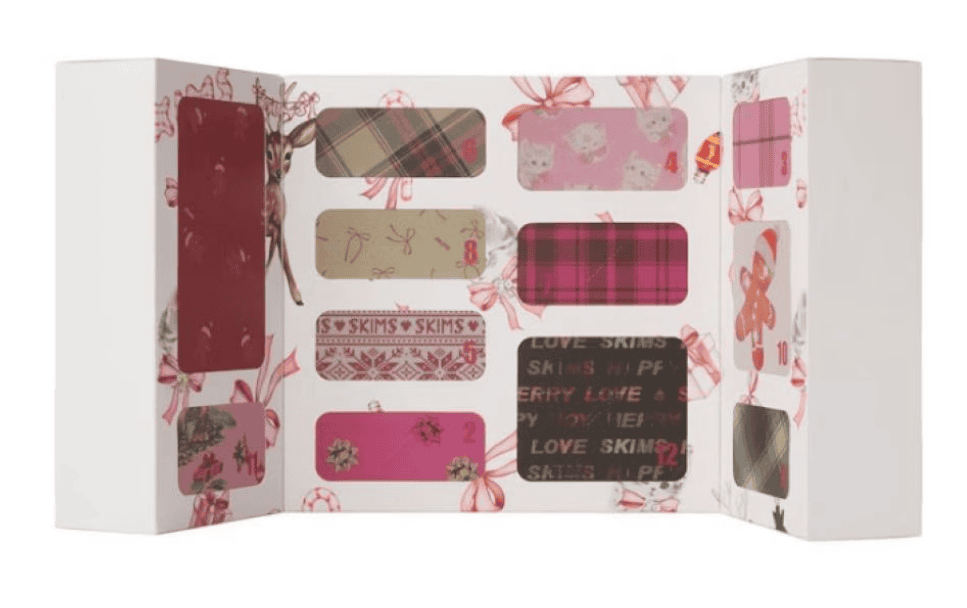
Kim Kardashian’s SKIMS is facing unexpected holiday-season criticism after its $148 accessories advent calendar sparked widespread disappointment among customers. What was promoted as a festive collection of everyday essentials and playful surprises quickly became a social media talking point, with shoppers questioning whether the contents justified the premium price.
Following a wave of negative reactions, SKIMS has officially addressed the controversy and offered refunds to customers who felt the limited-edition product failed to meet their expectations. The response has brought fresh attention to the brand’s holiday strategy and raised questions about the growing expectations surrounding celebrity-backed fashion products.
SKIMS Responds to Backlash Over Its $148 Advent Calendar
The controversy gained momentum after customers began sharing videos and comments about their experiences with the SKIMS accessories advent calendar. While the product promised 12 days of surprises, some buyers felt the actual contents fell considerably short of what they expected for a $148 purchase.
On November 8, 2026, SKIMS acknowledged the criticism and confirmed that it was aware of customer dissatisfaction.
The brand explained that the calendar had not met expectations for some shoppers. As a result, it personally contacted everyone who purchased the product and offered two options: a full refund or SKIMS store credit that could be used toward other merchandise.
The company also emphasized that customer feedback would influence its approach to future product launches.
This response represents an effort to address the complaints directly rather than allow the negative reaction to continue without clarification.
What Was Inside the SKIMS Accessories Advent Calendar?
The limited-edition SKIMS advent calendar was advertised as a 12-day holiday experience featuring a mixture of playful accessories and practical everyday items.
However, the contents revealed by customers included relatively small accessories such as:
- Hair ties and bobby pins.
- Decorative ornaments.
- Keychains.
- Small novelty accessories.
- Other miscellaneous trinkets.
Although these products may appeal to shoppers looking for everyday accessories, some customers questioned whether the collection offered enough value at its $148 retail price.
The disagreement largely centered on expectations. Advent calendars are traditionally associated with daily surprises, and premium versions often attract buyers through a combination of presentation, product variety and perceived value.
For SKIMS customers, the issue was not necessarily the usefulness of individual items. Instead, it was whether the overall collection felt substantial enough to justify its price.
The calendar is currently listed as waitlisted on the SKIMS website, although that status does not necessarily indicate whether the company plans to restock it.
Viral TikTok Video Fuels Customer Complaints
Social media played a major role in turning the SKIMS advent calendar into a wider fashion and entertainment story.
One particularly popular TikTok video, reportedly attracting nearly 65 million views, featured a disappointed customer unboxing the product and showing viewers what she received.
Her reaction quickly captured attention as she questioned the price and expressed frustration with the selection of accessories.
The video encouraged other shoppers to share their opinions, with many agreeing that the contents did not appear particularly impressive for a luxury-priced holiday product.
Some commenters humorously described the calendar as a collection of forgotten household items, while others suggested that the accessories looked like miscellaneous objects someone might discover between their car seats.
The criticism also included accusations that the product was a poor-value purchase.
However, the reaction highlights an important aspect of modern online shopping: customers increasingly rely on real-life unboxing videos before deciding whether a product deserves their money.
When an item becomes popular through social media, its actual contents can quickly become part of a much larger public conversation.
Why the $148 SKIMS Advent Calendar Sparked Debate
The controversy illustrates the challenges brands face when marketing premium products in an environment where consumers can immediately compare expectations with reality.
A $148 advent calendar creates certain expectations, particularly when it carries the name of a globally recognized fashion brand.
Customers may anticipate exclusive merchandise, carefully selected products, attractive packaging and a collection that feels worth the investment.
When the experience does not match those expectations, even relatively small products can trigger significant disappointment.
There is also a difference between a product’s individual retail value and its perceived overall value. A collection can contain several usable accessories without necessarily feeling like a worthwhile purchase to everyone.
For SKIMS, the situation demonstrates why clear product descriptions and transparent presentation are especially important for limited-edition releases.
Shoppers want to understand what they are buying, particularly when the price is significantly higher than that of an ordinary assortment of accessories.
SKIMS Is No Stranger to Controversial Product Launches
Although the advent calendar has attracted considerable attention, it is not the first time SKIMS has generated debate over an unusual product.
In 2025, the brand faced reactions after introducing a faux pubic hair thong, a novelty-style item that quickly became a topic of online discussion.
Kim Kardashian subsequently addressed the response, admitting that she was surprised by the amount of attention the product received.
She explained that the concept originated from a photoshoot and was intended to be a fun, unconventional idea.
That launch demonstrated how unusual products can generate publicity, even when public reactions are divided.
However, the advent calendar situation presents a slightly different challenge. While novelty products can attract attention simply because they are unexpected, customers spending $148 on a holiday collection may place greater importance on practical value and product quality.
For a brand built around fashion, comfort and lifestyle accessories, maintaining that balance is essential.
Celebrity Brands Face Growing Expectations From Consumers
SKIMS is part of a much larger trend involving celebrities who have transformed their personal influence into successful beauty, fashion and lifestyle businesses.
Names such as Rihanna, Selena Gomez, Beyoncé and Hailey Bieber have established recognizable brands that reach audiences well beyond their entertainment careers.
Rihanna’s Fenty Beauty helped bring greater attention to inclusive foundation shades when it launched in 2017. Selena Gomez introduced Rare Beauty in 2020, while Beyoncé expanded into haircare with Cécred.
Hailey Bieber’s Rhode also demonstrated the commercial potential of celebrity-led beauty businesses, eventually being acquired by e.l.f. Beauty in a deal valued at $1 billion in 2025.
Other celebrities have explored different areas of the beauty and personal care market:
- Lady Gaga: Founded Haus Labs, a cosmetics brand known for expressive makeup products.
- Victoria Beckham: Developed a luxury beauty collection alongside her fashion label.
- Gwyneth Paltrow: Expanded her Goop lifestyle business into skincare and beauty.
- Jennifer Lopez: Introduced a skincare line inspired by her signature glowing complexion.
- Tracee Ellis Ross: Created Pattern, a haircare brand focused on curly, coily and tightly textured hair.
- Serena Williams: Launched Wyn Beauty with an emphasis on makeup designed with deeper skin tones in mind.
These businesses demonstrate how celebrity recognition can help introduce products to large audiences. Nevertheless, visibility alone does not guarantee long-term customer loyalty.
Consumers increasingly expect celebrity brands to deliver consistent quality, thoughtful product development and transparent value.
What the SKIMS Controversy Means for Future Holiday Releases
The reaction to the SKIMS accessories advent calendar offers an important lesson for brands planning seasonal collections.
Holiday products are often purchased as gifts or special treats. Consequently, customers may expect more than everyday merchandise placed inside festive packaging.
For premium brands, successful seasonal launches depend on several factors:
- Clear expectations: Product descriptions should accurately communicate what customers will receive.
- Perceived value: The overall selection should feel appropriate for the advertised price.
- Product quality: Small accessories still need to meet the brand’s quality standards.
- Customer communication: Companies should respond quickly when buyers raise legitimate concerns.
- Consumer feedback: Reviews and social media discussions can reveal problems that brands might otherwise overlook.
SKIMS has already taken a step toward addressing the immediate situation by offering refunds or store credit.
Whether that response will restore customer confidence remains to be seen. However, the company’s acknowledgment of the complaints suggests that customer satisfaction will play a role in shaping future releases.
Final Thoughts: Can SKIMS Move Past the Advent Calendar Backlash?
Kim Kardashian’s SKIMS has built a major presence in the fashion and lifestyle market, but the $148 advent calendar controversy shows that even highly recognizable brands are not immune to customer criticism.
The viral TikTok reaction turned a limited-edition holiday product into a widely discussed shopping story. More importantly, it highlighted the growing importance of perceived value, transparency and customer expectations.
By offering refunds and acknowledging the feedback, SKIMS has taken steps to address the dissatisfaction.
Ultimately, the success of future launches will depend on whether the brand can translate its popularity into products that consistently meet shoppers’ expectations. In an increasingly competitive celebrity-business landscape, a recognizable name may attract customers, but delivering value is what encourages them to return.












Comments are closed.