
Justin Bieber at Coachella: Pop’s Fallen Angel Rewrites the Rules of Performance
When Justin Bieber opened his Coachella set by locking eyes with a camera on the floor, it didn’t feel like a gimmick — it felt like a confrontation. Not just with the audience in the desert, but with millions watching through screens, scattered across time zones and emotional distances.
In that moment, the idea of “live performance” fractured. Bieber wasn’t just onstage at Coachella — he was everywhere at once. And more importantly, he seemed to be asking a question: what does presence even mean in pop music anymore?
Stripping Away the Spectacle
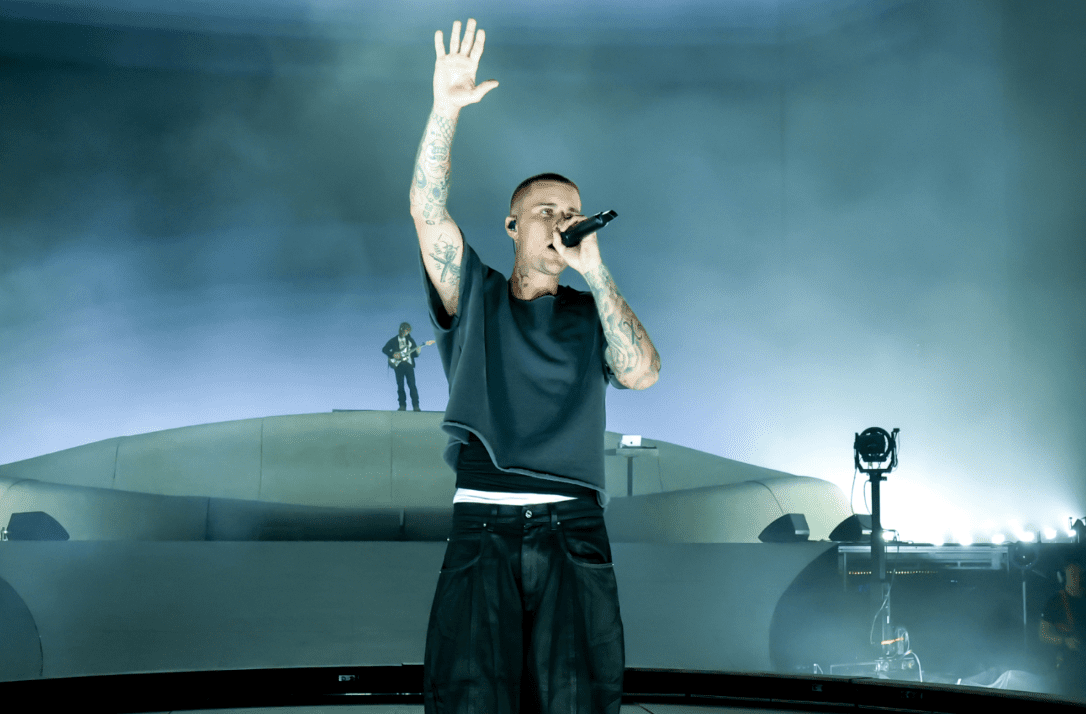
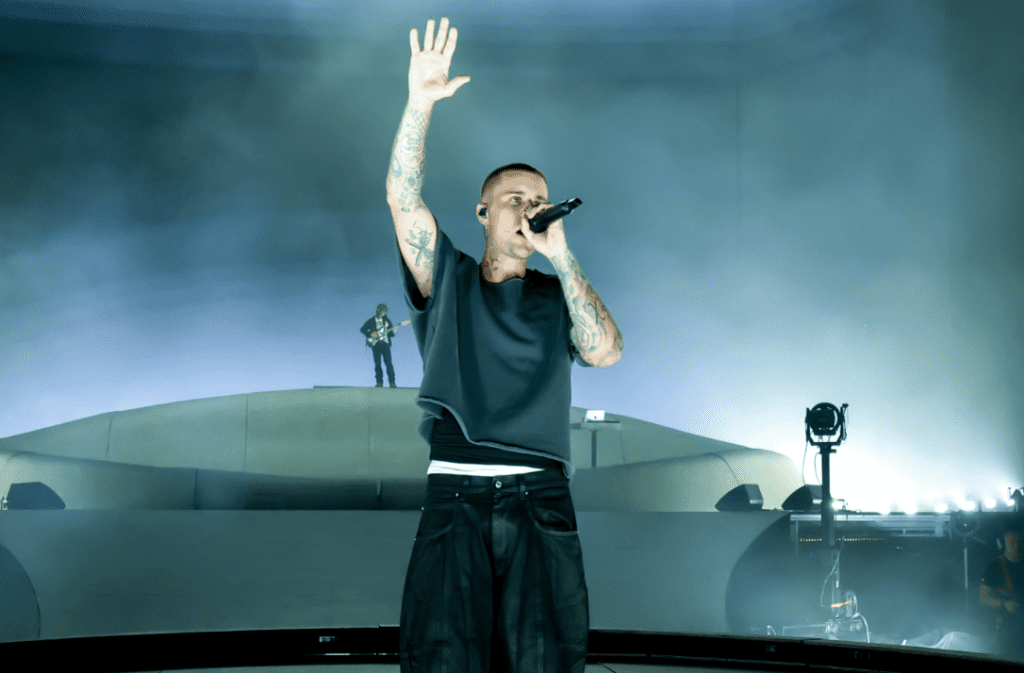
Gone were the expected markers of a headline performance — no elaborate choreography, no towering visuals, no euphoric excess. Instead, Bieber stood largely alone on a sparse, almost sculptural stage, accompanied at times by nothing more than a laptop and his own voice.
It was a radical aesthetic decision, especially for an artist whose career was built on high-gloss pop precision. But this wasn’t minimalism for the sake of style — it felt closer to exposure.
The songs, particularly from his recent projects SWAG and SWAG II, leaned into emotional ambiguity: lyrics that hovered between confession and abstraction, anchored more in mood than narrative. His voice — still technically pristine — carried a new weight, less eager to impress, more willing to linger in imperfection.
This is Bieber in his post-spectacle era. And he’s not trying to entertain you in the traditional sense.
The Long Shadow of Child Stardom
It’s impossible to watch Bieber now without considering the architecture of his past. Discovered as a teenager, shaped by an industry that thrives on youth and projection, he became less an artist than a symbol — of fame, of desire, of global consumption.
Artists who rise that quickly rarely get the luxury of reinvention. They are expected to evolve, but only within boundaries set by the audience that made them famous.
Bieber’s current phase feels like a rejection of that contract. Not loudly, not rebelliously — but through subtraction. By removing the spectacle, he removes the illusion. What’s left is something less comfortable: a performer who doesn’t always seem interested in performing.
Faith, Fracture, and the Search for Meaning
Midway through the set, the emotional tone shifted. Acoustic arrangements gave way to something more intimate, almost devotional. Songs like “Glory Voice Memo” and “Everything Hallelujah” introduced a spiritual undercurrent that has long been part of Bieber’s identity but rarely this exposed.
His relationship with faith — once filtered through public affiliations like that with former pastor Carl Lentz — now appears more internal, less performative. Onstage, it translated into something raw: a performer not just singing, but searching.
It reframed his entire catalogue. The heartbreak anthems, the love songs, the melancholic refrains — all began to feel like fragments of a larger, unresolved conversation between belief and disillusionment.
Nostalgia as Performance Art
Then came the most unexpected pivot of the night.
Standing behind his laptop, Bieber began revisiting his own past — playing early YouTube videos that first launched his career. Covers of songs by Chris Brown and Ne-Yo flickered across massive screens, while he watched alongside the audience.
It was part nostalgia, part self-examination.
There was something almost surreal about it — a global superstar reacting in real time to his own origin story. The effect wasn’t triumphant. It was introspective, even slightly disorienting. He wasn’t celebrating who he was; he was studying who he had been.
In an age obsessed with curated identity, Bieber turned memory into a live medium.
The Party Returns — But Differently
Just as the set risked collapsing into solitude, the energy shifted again. Collaborators began to appear: Dijon, Wizkid, Tems, and Mk.gee.
Color flooded the stage. Movement returned. For a moment, the performance resembled something closer to a traditional concert — communal, energetic, alive.
But even this felt intentional. Not a return to spectacle, but a reintroduction of it. As if Bieber was testing how — or whether — shared joy could still exist after everything had been stripped away.
Public Reaction: Genius or Detachment?
Predictably, the response has been divided. Some critics and fans have dismissed the performance as underwhelming, questioning whether a reported multi-million-dollar set should feel so restrained, so deliberately incomplete.
Others see something more compelling: an artist actively deconstructing what a pop concert is supposed to be.
Because what Bieber presented wasn’t a show in the conventional sense. It was a sequence of emotional states — loneliness, reflection, confrontation, connection — loosely stitched together in real time.
Not everyone wants that from a headliner. But that may be the point.
Conclusion: Reinvention Without Resolution
There is a temptation to frame this moment as a comeback — a narrative pop culture loves. But that feels too neat for what Justin Bieber is doing right now.
This isn’t a return. It’s a dismantling.
At Coachella, Bieber didn’t offer clarity, closure, or even consistent energy. Instead, he presented something far more unstable: a portrait of an artist in transition, still negotiating the weight of fame, identity, and expectation.
The real question isn’t whether he has risen again. It’s whether he’s interested in rising at all — or if he’s building something entirely different in the space where pop spectacle used to be.



Comments are closed.