
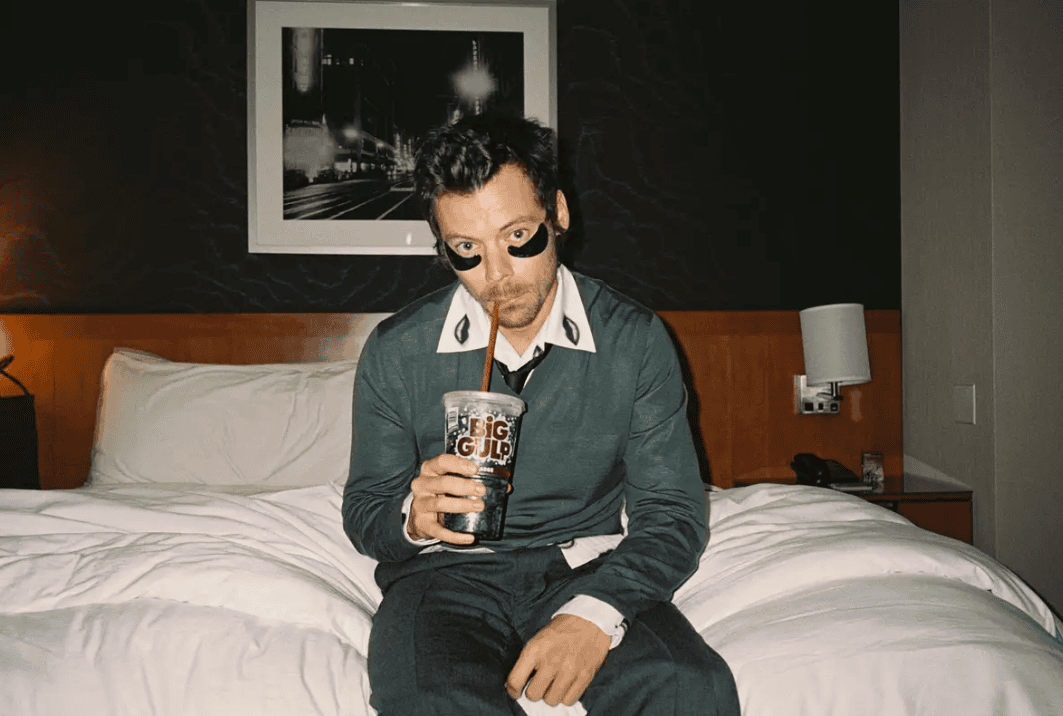
The pop star once found comfort in the constant motion of touring. Now, as he returns to the stage, Harry Styles is discovering something more valuable: an identity that exists beyond the spotlight.
For Harry Styles, the stage has never simply been a place to perform. It has been a place to become.
For much of his adult life, the British singer has lived in motion — from One Direction’s global ascent to a solo career defined by stadiums, fashion campaigns, cinema, sold-out shows and an unusually devoted audience. Touring became more than a job. It became a rhythm, an identity and, eventually, a kind of emotional architecture.
So when the music stopped, silence could feel strangely loud.
In a new interview with W Magazine, Styles reflects on the uncomfortable relationship he once had with being away from the stage. Earlier in his career, he says, spending extended periods at home could leave him restless. Having started performing professionally at such a young age, touring had become so intertwined with his sense of self that he sometimes struggled to understand who he was without it.
“I would feel quite uncomfortable with stretches at home,” he admits.
It is a surprisingly revealing confession from a performer whose public image has long suggested effortless confidence. Styles has built a career around movement — musical reinvention, theatrical fashion, global travel and the electric exchange between performer and audience. Yet beneath the carefully constructed image was a more complicated question: who is Harry Styles when nobody is watching?
The Person Behind the Performer
Styles’ evolution has always been partly about refusing to remain one thing.
He entered the public consciousness as a member of One Direction, one of the biggest pop groups of the 2010s. His subsequent solo career transformed him from boy-band star into an artist with a distinct visual and musical identity, while his fashion choices challenged traditional ideas of masculinity and helped make him one of the defining cultural figures of his generation.
But success at that scale can blur the boundary between a person and the character the world expects them to be.
The stage offers certainty. There is a microphone, a crowd, a setlist, lights, choreography and thousands of people responding to the same moment. Away from it, there is simply life.
For Styles, learning to inhabit that quieter space appears to have become one of his most important forms of personal growth.
“In the time that I took away from touring, I watered a side of my life I hadn’t paid much attention to previously,” he explains.
The metaphor is telling. Rather than describing his time away as a period of inactivity, Styles describes it as cultivation. Something existed beyond the career that simply had not received enough attention.
That distinction matters.
The Strange Power of Stepping Away
Pop culture often rewards constant visibility.
Artists are expected to release, tour, promote, post, appear, perform and reinvent themselves before the previous version of them has even had time to settle. In an industry increasingly built around perpetual attention, disappearing can feel almost like failure.
Styles seems to have discovered the opposite.
Distance from the stage gave him a chance to understand that his career could be something he participates in rather than something that defines every part of him.
“The idea of not touring is less frightening to me,” he says.
It is perhaps one of the most significant statements in the interview.
For an artist who spent years performing for enormous audiences, the ability to accept that he does not always need to be performing represents a different kind of confidence. Not the confidence of commanding a stadium, but the quieter confidence of knowing that the stadium does not determine your worth.
From Idol to Individual
There is an interesting irony in Styles’ story.
The very qualities that made him such a compelling pop star — charisma, openness, style and emotional accessibility — also created an enormous expectation around his public persona. Fans have followed his transformation from teenage One Direction member to global solo artist, watching each era become part of a larger cultural narrative.
But becoming comfortable outside that narrative may be the most mature chapter yet.
Styles acknowledges that he once struggled with the question of identity beyond performance.
“Who am I if I don’t do this?” was, in his words, once a frightening question.
Now it seems to be one he can answer.
He has a life beyond the stage. He has interests, relationships, experiences and private moments that do not need to become content. He can be an artist without needing to be an entertainer every second of the day.
And perhaps that is why returning to the stage can now feel more enjoyable.
The Ritual of Coming Back Down to Earth
There is an unexpectedly intimate detail in Styles’ current relationship with performance: the shower he takes immediately after every show.
At first glance, it sounds like an ordinary post-concert ritual. But for Styles, it has become something more symbolic.
After spending hours in front of thousands of people, inhabiting the heightened version of himself that exists under stage lights, he steps backstage and washes it away.
The contrast is almost cinematic.
One moment, he is standing before a massive audience, surrounded by lights and sound, occupying what he describes as a “very godlike position.” Minutes later, he is simply a person standing naked in a shower.
The ritual creates a boundary between Harry Styles the performer and Harry Styles the individual.
It is a reminder that the spectacle ends.
And that is precisely the point.
Fame Without Worship
Perhaps the most interesting part of Styles’ reflection is his changing understanding of the relationship between artist and audience.
When he was younger, he says, acknowledging that the performance was not ultimately about him could have been frightening.
Now, he finds it liberating.
“We’re all there for the same thing,” he explains.
That perspective fundamentally changes the traditional mythology of the pop star.
The superstar is no longer the centre of the universe. The concert becomes a shared experience rather than a hierarchy, with the artist and audience participating in something larger than either of them.
It is a subtle but profound shift.
For someone who has spent his career being watched, photographed, discussed and analysed, surrendering the idea that everything revolves around him may be one of the most freeing things he has learned.
A New Era of Harry Styles
Styles is now entering another major chapter.
His fourth solo album, Kiss All the Time. Disco, Occasionally., released earlier this year and reached No. 1 on the Billboard 200 for two weeks, with “Aperture” becoming a Hot 100-topping single. His current Together, Together tour brings him back into the enormous live environment that once defined his existence.
He is also preparing for an extraordinary 30-night run at Madison Square Garden in New York, beginning August 26 and continuing through October 31.
The circumstances are different this time.
He is returning to the stage not because he needs it to understand himself, but because he can enjoy it without losing himself inside it.
That may be the greatest evolution of Harry Styles yet.
The Freedom to Leave the Spotlight
There is something deeply contemporary about Styles’ realization.
In an era where visibility is treated as currency and personal identity is increasingly performed online, choosing to step away can feel radical. The pressure to remain interesting, productive and visible never really switches off.
Styles is learning to switch it off anyway.
His story is not simply about a musician taking a break from touring. It is about what happens when someone who has been defined by a public identity begins to reclaim the private one.
The stage will always be part of Harry Styles.
So will the screaming crowds, the clothes, the music, the cameras and the extraordinary cultural machine surrounding him.
But they no longer have to be the whole story.
Perhaps the most powerful version of Harry Styles is not the one standing beneath thousands of lights.
It is the one who can walk away from them, close the door, take a shower, and know exactly who he is when the music stops.









Comments are closed.