
When an Icon Doesn’t Need Permission
There are performances that define a night—and then there are moments that quietly redefine an entire cultural hierarchy. On a Friday evening in the California desert, during a set that was never meant to be hers, Madonna stepped onto the stage at Coachella and reminded everyone of a simple, enduring truth: pop music doesn’t move forward without acknowledging who built it.
She wasn’t the headliner. She wasn’t even announced as one. And yet, for a few charged minutes, the festival—and by extension, the internet—reoriented itself entirely around her presence.
A Collision of Eras That Felt Inevitable
Sabrina Carpenter was already in full command of her headline set, moving through a catalog that has firmly positioned her as one of pop’s defining voices of the moment. The energy was sharp, confident, unmistakably hers. This was not a rising star borrowing the spotlight—it was an artist standing fully inside it.
And then Madonna appeared.
Not with spectacle, not with theatrics—just with the kind of quiet authority that only comes from decades of cultural dominance. The transition was seamless, almost surreal. Two artists from entirely different eras occupying the same stage, not in contrast, but in conversation.
Together, they moved through a medley that bridged time itself—Madonna’s “Like a Prayer” and “Vogue” threading effortlessly into Carpenter’s contemporary pop world. Reports of an unreleased track from Madonna’s forthcoming Confessions II added another layer of intrigue, suggesting that even now, she is less interested in revisiting the past than in reshaping the present.
Fashion as Language, Not Decoration
If pop music is as much visual as it is sonic, then this moment was meticulously articulated.
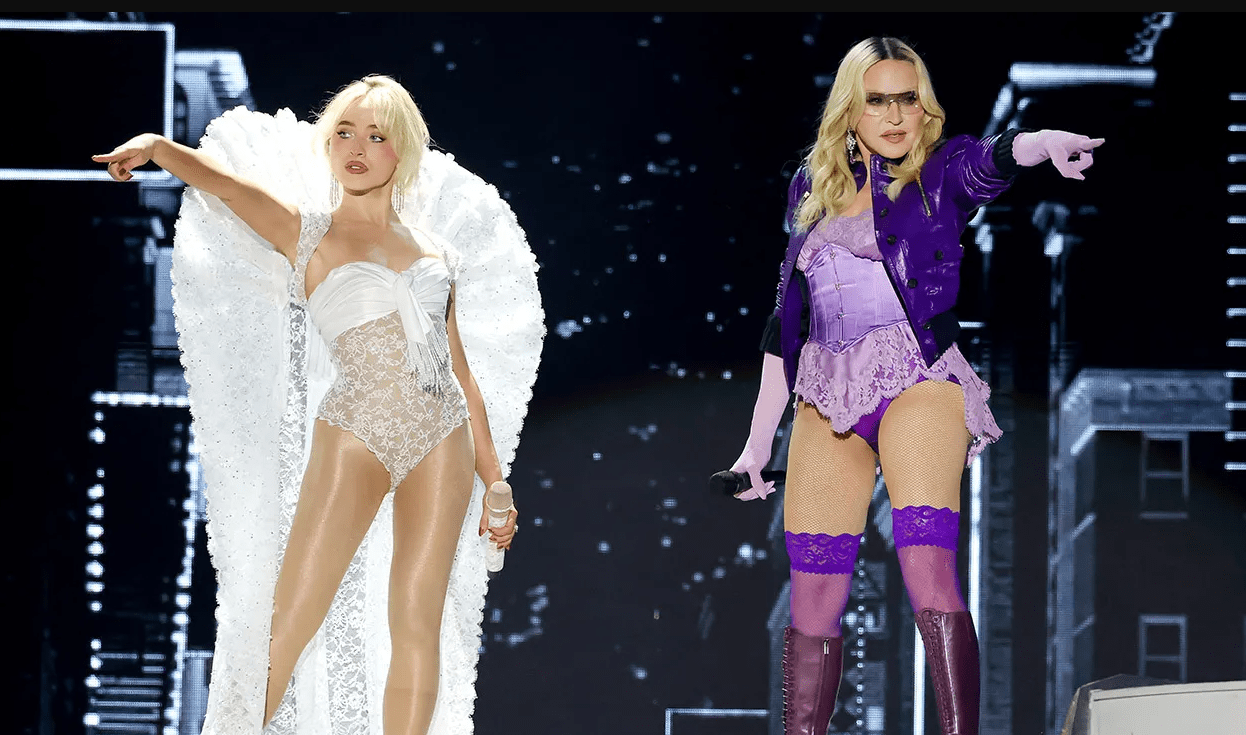
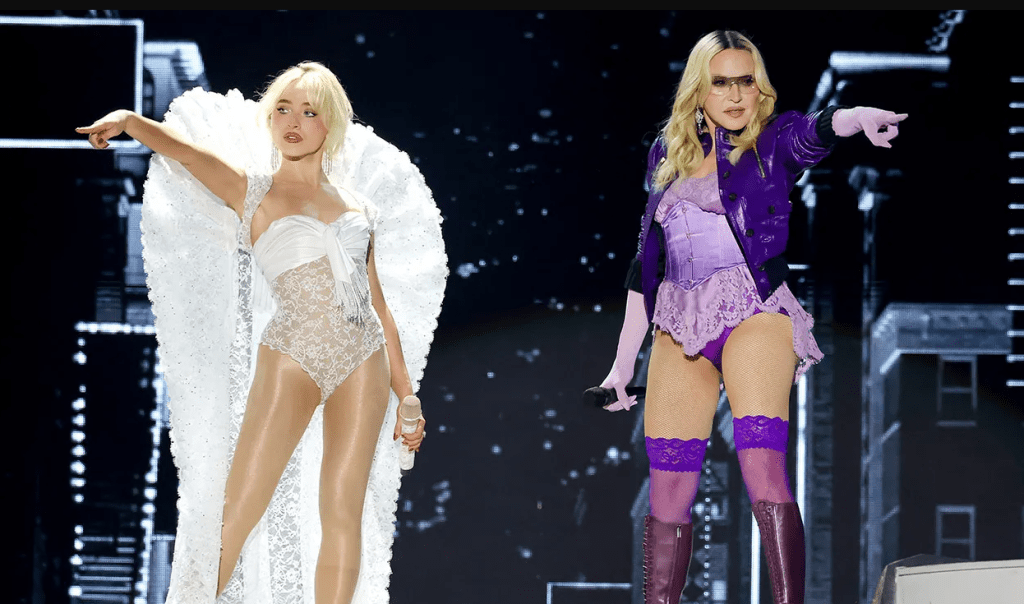
Madonna’s return to her Confessions on a Dance Floor aesthetic—lace corsetry paired with those unmistakable purple boots—was not nostalgia. It was authorship. A reminder that what now reads as “iconic” was once radical, deliberate, and entirely hers.
Beside her, Carpenter mirrored the visual language without imitation: a white lace corset, soft yet structured, echoing the same codes of femininity and control that Madonna has spent a career redefining. It was styling as dialogue—two generations speaking in the same aesthetic vocabulary, each fluent in its own way.
In a culture obsessed with reinvention, Madonna offered something more powerful: continuity.
The Subtle Power of Mentorship
What made the moment resonate beyond spectacle was its underlying dynamic. Madonna did not arrive to reclaim dominance; she arrived to share space. And in doing so, she reframed what legacy looks like in modern pop.
For decades, the industry has struggled with how to position its icons alongside its newcomers—often forcing a narrative of replacement, as though relevance must be transferred rather than expanded. This performance quietly dismantled that idea.
Carpenter did not shrink beside Madonna. She held her ground, matched her energy, and in doing so, proved something essential: influence does not diminish the present—it sharpens it.
Madonna, in turn, demonstrated a different kind of power. Not just the ability to command attention, but the instinct to redirect it.
Reinvention as Strategy, Not Survival
Madonna’s longevity has never been accidental. It is the result of a career built on precision—on understanding not just where culture is, but where it is going.
At 67, she does not chase relevance. She engineers moments that make relevance bend toward her.
Her appearance at Coachella was not a spontaneous gesture. It was a calculated intersection of timing, aesthetics, and cultural momentum. A reminder that pop music is not linear—it is cyclical, layered, constantly referencing itself.
And Madonna remains at the center of that cycle, not as a relic, but as an active architect.
Pop Music, Seen in Full Circle
What unfolded on that stage was more than a collaboration. It was a visual representation of how pop culture sustains itself.
Generations do not replace each other—they overlap. They borrow, reinterpret, and evolve. Madonna once disrupted the system she now represents. Carpenter now moves within a landscape Madonna helped construct.
For a brief moment, that entire process became visible.
Two artists. Two timelines. One shared language: the ability to create something that feels immediate, undeniable, and impossible to replicate.
Conclusion: The Difference Between Presence and Power
There is a reason moments like this linger long after the lights go down. It isn’t just about surprise or nostalgia. It’s about recognition.
Madonna does not need a headline slot to dominate a cultural conversation. She does not need reinvention to remain relevant. What she possesses is something far rarer: permanence.
At Coachella, she didn’t just appear. She recalibrated the room—reminding a new generation that before pop could evolve, it had to be rewritten.
And she was the one who wrote it.





Comments are closed.