
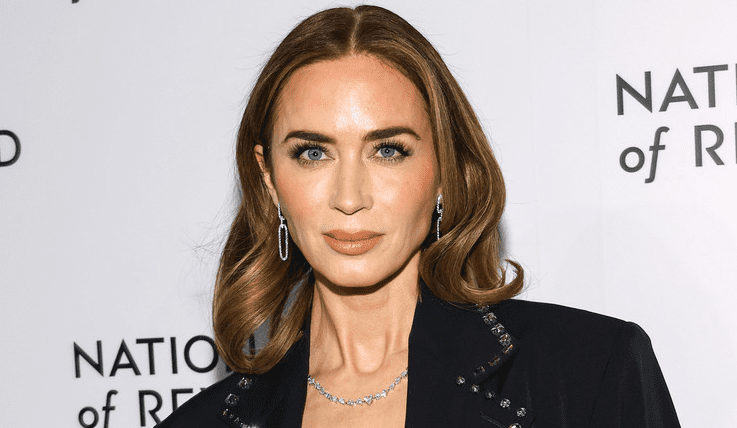
The Art of Being Unmistakable Without Trying Too Hard
There are actors who arrive on screen, and there are those who quietly reshape the atmosphere around them. Emily Blunt belongs firmly to the second category. Whether she is slipping into the razor-sharp world of high fashion in The Devil Wears Prada, surviving a post-apocalyptic silence in A Quiet Place, or embodying emotional gravity in Oppenheimer, Blunt has built a career defined not by volume, but by precision.

In an entertainment era often driven by spectacle and saturation, her presence feels almost countercultural: controlled, intelligent, and deeply considered. And perhaps that is exactly why her relevance has only intensified.
From London Theatre to Global Screens: A Career Built on Control and Contrast
Blunt’s trajectory begins far from Hollywood’s polished machinery. Her early work on the London stage—most notably in The Royal Family alongside Judi Dench—introduced her as an actor shaped by discipline rather than hype. But it was her breakout role in The Devil Wears Prada that quietly shifted her from promising talent to cultural fixture.
As Emily, the sharply hilarious and emotionally brittle assistant navigating Miranda Priestly’s empire, she delivered something unexpectedly enduring: a character who was both comic and tragic, sharp-tongued yet deeply human. In retrospect, the role became a kind of fashion-era archetype, still referenced in conversations about workplace power dynamics, aesthetic identity, and ambition under pressure.
That film didn’t just launch her global visibility—it reframed how audiences understood her range.
Reinvention Without Erasure: The Range Behind the Persona

What followed was not repetition, but deliberate divergence. Blunt moved through genres with unusual ease: sci-fi intensity in Edge of Tomorrow, moral tension in Sicario, emotional silence in A Quiet Place, and period spectacle in Mary Poppins Returns. Each performance felt like a refusal to be boxed in.
Her collaboration with filmmaker Christopher Nolan in Oppenheimer marked another pivot—less about reinvention and more about consolidation. As Katherine “Kitty” Oppenheimer, she delivered a restrained yet emotionally charged performance that earned her an Academy Award nomination, confirming what critics had long suggested: Blunt’s strength lies in what she withholds as much as what she reveals.
The Cultural Mirror: Fashion, Public Image, and Modern Celebrity
Off-screen, Blunt occupies a different but equally influential space in the cultural imagination. Red carpet appearances—whether at the Oscars luncheon or global premieres—often spark the same response: effortless refinement without performance of effort.
Recent moments, from archival-style sneaker styling trends to high-profile fashion statements at global events like the Met Gala, reflect a broader shift in how audiences engage with celebrity style. Blunt’s aesthetic choices consistently echo restraint rather than excess, aligning her with a growing cultural preference for authenticity over theatricality.
Even her fashion legacy is inseparable from The Devil Wears Prada, a film that continues to ripple through fashion discourse nearly two decades later, shaping how audiences interpret power dressing and editorial authority.
Partnership, Privacy, and the Architecture of Stability
In an industry where relationships are often performative, Blunt’s long-term marriage to actor John Krasinski has become part of her public narrative—though never its defining feature.
Together since 2010, the pair have built a creative and personal partnership that extends into their professional worlds, most notably through A Quiet Place. Their collaboration reflects a rare alignment in Hollywood: intimacy without overexposure, synergy without dependency on spectacle.
Their dynamic, often described in interviews as collaborative and grounded, offers a counterpoint to the volatility typically associated with celebrity couples.
The Devil Wears Prada Effect: Legacy, Sequel Culture, and Enduring Relevance
Few films maintain cultural longevity the way The Devil Wears Prada has. Its dialogue, aesthetic codes, and workplace satire continue to circulate through memes, fashion commentary, and generational rewatching.
Talk of sequels and reunions has only intensified its mythos, with renewed interest in how its characters—particularly Blunt’s Emily—would evolve in a contemporary media landscape shaped by digital fashion cycles and influencer economies.
What makes this continued fascination compelling is not nostalgia alone, but recognition: the film understood ambition, exhaustion, and aesthetic labor before these concepts became mainstream cultural vocabulary.
A Career Still Expanding, Not Settling
At 43, Blunt occupies a rare position in Hollywood: established enough to be iconic, yet still evolving in unexpected directions. Her filmography resists stagnation, and her public presence avoids overexposure—a balance few sustain in the current entertainment ecosystem.
She represents a version of stardom that feels increasingly rare: one built on craft, adaptability, and quiet authority rather than constant reinvention for visibility’s sake.
Closing: The Power of Restraint in an Age of Excess
Emily Blunt’s career is not defined by volume, but by calibration. In a cultural moment that rewards loudness, she has built her legacy on precision—choosing roles, collaborators, and public presence with an instinct that feels almost architectural.
Her enduring appeal lies not in transformation, but in consistency: the ability to remain recognizably herself while continuously expanding what that self can contain. In doing so, she has become one of contemporary cinema’s most quietly influential figures—proof that restraint, when executed with intelligence, is its own form of power.









Comments are closed.