


Introduction
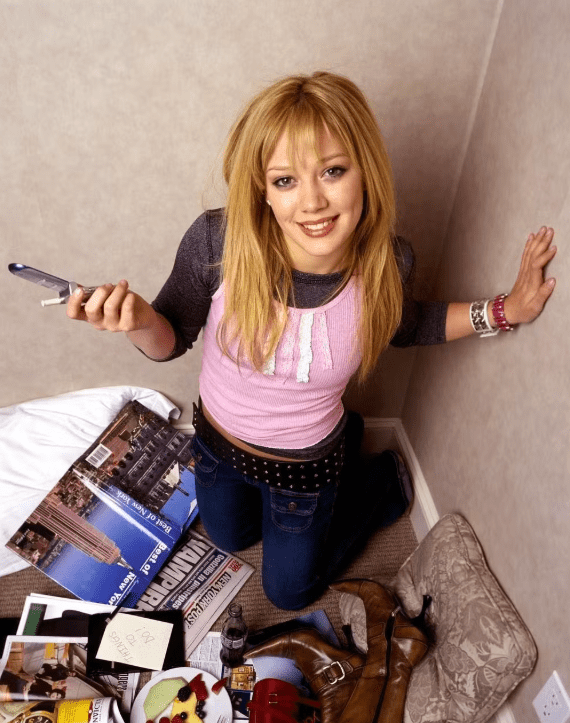
Before “influencer culture” had a name, before streaming reshaped celebrity into algorithmic visibility, there was a generation-defining star who quietly set the template for what it meant to grow up famous. Hilary Duff wasn’t just a Disney Channel favorite—she was the emotional center of early-2000s teen culture, a figure who blurred the line between fictional relatability and real-life stardom.
As nostalgia for the 2000s continues to dominate pop culture cycles, Duff’s legacy feels less like a throwback and more like a blueprint.
The Girl Who Defined a Generation
For millions of millennials, Duff’s breakthrough role in Lizzie McGuire wasn’t just television—it was identity formation. She played the awkward, hopeful, slightly chaotic version of adolescence that felt startlingly real at a time when teen media was often exaggerated or idealized.
Lizzie McGuire wasn’t cool in the traditional sense. That was the point. She was uncertain, expressive, and constantly caught between who she was and who she wanted to be. In hindsight, that relatability became Duff’s superpower. She didn’t perform perfection; she performed growing pains.
And audiences followed her everywhere—from living rooms to cinemas, where The Lizzie McGuire Movie turned a Disney character into a global teen phenomenon.
From Disney Channel to Cultural Mainstream
Unlike many child stars confined to a single lane, Duff quickly expanded her reach. Films like A Cinderella Story, Cheaper by the Dozen, and Agent Cody Banks cemented her status as a defining face of early-2000s teen cinema.
She wasn’t positioned as a niche Disney product—she was everywhere. Mall posters, CD racks, magazine covers. In a pre-social media era, Duff’s presence was omnipresent in a way that feels almost impossible today.
At the same time, she entered music with surprising success. Her album Metamorphosis didn’t just capitalize on fame—it helped define the sound of early-2000s pop, producing tracks like “So Yesterday” and “Come Clean” that still circulate through nostalgia-driven playlists and TikTok revivals.
The Price of Growing Up Famous
Behind the polished image of a teen idol, Duff’s reality was far more complicated. Fame arrived early, fast, and without pause. Like many young stars of her era, she was navigating adulthood under constant public scrutiny.
In interviews over the years, she has reflected on the pressures of body image and the expectations placed on young women in entertainment. The industry that built her image was also the one that tried to define its limits.
Duff’s teenage years were shaped not only by fame, but by negotiation—between public perception and private identity, between who she was and who she was expected to be.
This tension became a defining thread of her evolution.
Breaking the Disney Illusion
By the mid-2000s, Duff began consciously stepping away from the “clean Disney girl” image that had made her famous. Her transition wasn’t scandal-driven, but strategic. A cover shoot for Maxim marked a deliberate repositioning: from teen idol to adult performer.
But unlike many child stars who struggled to maintain stability in adulthood, Duff’s trajectory took a more grounded path. She didn’t chase shock value—she rebuilt her career slowly, intentionally, and often quietly.
Reinvention Through Reinvention
In the 2010s, Duff found new creative footing in television with Younger. As Kelsey Peters, she played a sharp, ambitious publishing executive navigating a rapidly changing media world—a role that mirrored, in subtle ways, her own evolution in the entertainment industry.
It was a performance that didn’t rely on nostalgia. Instead, it reintroduced her to audiences as an adult actress with range, timing, and understated charisma.
This phase of her career marked something rare in Hollywood: a child star successfully transitioning without losing cultural relevance or authenticity.
A Life Beyond the Spotlight
Alongside acting and music, Duff expanded into writing, producing, and entrepreneurship, building a career that resisted the limitations often imposed on former teen stars. But perhaps more importantly, she built a public identity that felt unusually grounded.
She became open about motherhood, relationships, and the realities of balancing visibility with personal life. Not curated perfection, but lived experience.
That openness, in many ways, is what has sustained her relevance. She isn’t a relic of the 2000s—she is one of the few figures from that era who evolved with her audience instead of being left behind by it.
The Enduring Power of Relatability

What makes Hilary Duff’s legacy so enduring is not just her résumé—it’s her emotional accessibility. She represents a version of fame that feels human, imperfect, and longitudinal. You don’t just remember her roles; you remember growing up alongside her.
In today’s entertainment landscape, where reinvention is constant and attention spans are fragmented, Duff’s career feels almost old-fashioned in its continuity. And yet, that continuity is precisely what gives it weight.
She didn’t chase transformation for its own sake. She grew, publicly and privately, at a pace that mirrored her audience.
Closing Reflection
Hilary Duff’s cultural impact isn’t frozen in the early 2000s—it’s still unfolding. She remains a rare example of a star who didn’t burn out, fade away, or fracture under the weight of early fame. Instead, she adapted, softened, and matured in full view of a generation that did the same.
In many ways, she isn’t just part of millennial nostalgia. She is its emotional architecture.











Comments are closed.